
LEED 2012 – 2nd Public Comment – Materials & Resources (MR) Section
Do you have comments or questions on this draft? Discuss them below with your fellow LEED professionals. Substantive comments posted here during USGBC's second public comment period will be submitted to USGBC and considered "official" public comments.
More information on LEED 2012 certification and the second public comment
Materials and Resources (MR)
Major Changes
A Recycled Content prerequisite that was introduced in the first LEED 2012 draft is now gone. It would have required recycled content at 10% of the materials budget, with post-consumer and pre-consumer content valued equally.
Another prerequisite that is new to LEED 2012, Construction and Demolition Debris Management Planning, survived the first public comment period, but has some changes. It includes basic construction waste management requirements, including having a management plan in place, and targeting 20% diversion. Alternative Daily Cover (ADC) would not qualify as diverted debris.
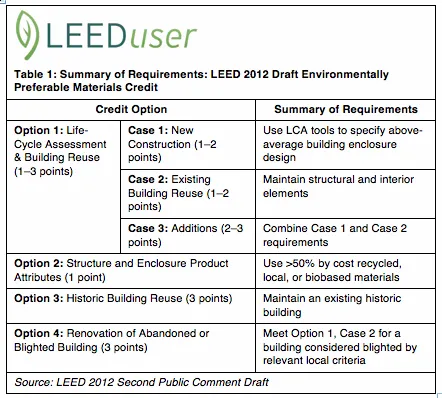
A new credit, Environmentally Friendly Construction and Enclosure (1–3 points), would replace the former Building Reuse credit, as well as incorporate aspects of the former recycled content and regional materials credits. This lengthy credit includes four options summarized in Table 1, and would move LEED toward more holistic, life-cycle-based materials evaluations rather than single-attribute credits.
This move toward multi-attribute materials considerations is reinforced throughout the new draft of the MR section, with the new credits Non-Structural Materials Transparency (1–2 points), Environmentally Preferable Non-Structural Products & Materials—Prescriptive Attributes (1 point), Responsible Sourcing of Raw Materials (1 point), and Avoidance of Chemicals of Concern in Building Materials (1 point). These credits are summarized in Table 2.
These credits represent a complete overhaul of the MR section since the first public comment, with the old Certified Wood, Regional Materials, Recycled Content, and Materials Reuse credits, along with the new Biobased Materials credit all being jettisoned in this draft.
This MR overhaul is sure to spark debate. Proponents of an “FSC or better” (for the Forestry Stewardship Council) policy for LEED will be pleased that FSC is the only forestry or biobased certification recognized under the Responsible Sourcing credit, and that the Materials Transparency credit has shifted away from Pilot Credit 43’s approach to recognizing other forestry certifications. Opponents of FSC-only, on the other hand, will be pleased that this draft maintains recognition of biobased materials without certification, something introduced with the first draft. Forestry industry leaders who have argued that LEED singles out wood for such stringent attention, making it “anti-wood,” should take note of new requirements for responsible sourcing of mined and extracted materials applying to concrete, steel, and other materials. Major certifications for those materials aren’t as available yet, but USGBC hopes to help spur their development.
Another noteworthy MR change is a shift away from the simple 500-mile radius defining “regional materials,” to use of a more targeted metric, the Core Based Statistical Area, as defined by the U.S. Census Bureau. According to the Census, this concept refers to “a metropolitan or micropolitan statistical area containing a substantial population nucleus, together with adjacent communities having a high degree of economic and social integration with that core.”
What do you think of these proposed changes? Please post your comments and questions below.