It’s all or nothing
Like most of the other low-emitting materials credits, this credit is all-or-nothing.
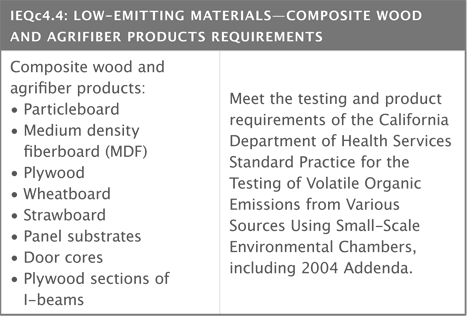
The credit language states that school projects have to use composite materials and laminating adhesives that meet the testing and product requirements of the California Department of Health Services protocol. This is a stringent chamber test that detects certain types of VOCs and determines the rate of offgassing.
Schools have six low-emitting materials credits, but can earn a maximum of four points from them, so choose four to pursue:
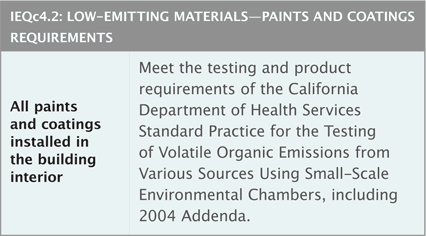
Schools have to meet the testing and product requirements of the California Department of Health Services Standard Practice for the Testing of Volatile Organic Emissions from Various Sources Using Small-Scale Environmental Chambers, including 2004 Addenda.
To get the full benefit of this credit, consider requiring VOC limits for tenant construction by incorporating either recommended compliant products, or recommending that tenants use compliant paints and coatings with specific VOC limits in a tenant guideline document (per SSc9: Tenant Design and Construction Guidelines).
Don’t allow the use of products that merely claim to be “low VOC.” Everyone specifying and purchasing products must actually find the products’ VOC content in grams per liter (g/L), which is usually found on the product’s technical data sheet or material safety data sheet, and compare that number with VOC limits listed for different uses determined by the South Coast Air Quality Management District (SCAQMD) Rule #1113 and Green Seal GS-11 and GS-03.
Like the similar credit, IEQc4.1: Low-Emitting Materials: Adhesives and Sealants, it shouldn’t cost you anything extra to earn this credit—it will just take some work. Your first priority should be to specify only paints and coatings that comply with the credit’s VOC limits, and enforce those specifications on the jobsite.