
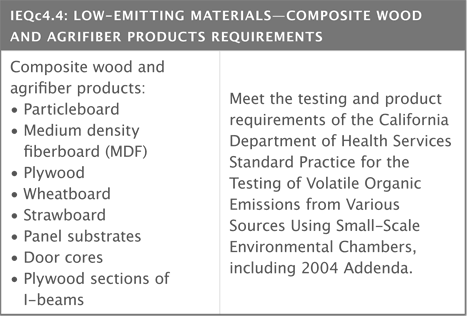
 The credit language states that school projects have to use composite materials and laminating adhesives that meet the testing and product requirements of the California Department of Health Services protocol. This is a stringent chamber test that detects certain types of VOCs and determines the rate of offgassing. This reference standard is much more stringent than the requirements for this credit in LEED-NC and rating systems, which simply prohibit products with urea-formaldehyde in binders or glues. These products do not need testing to comply.
However, the USGBC put out an erratum for earlier versions of LEED for Schools allowing projects to pursue the LEED-NC no-added-urea-formaldehyde requirement rather than the California standard. This option applies to LEED for Schools 2009 as well. That means that you have the option of using products that meet either standard. Advice on both paths are included in the following Bird’s Eye View introduction, and in the Checklists tab.
Products that meet Schools testing requirement can be hard to find
As not many products have gone through chamber testing according to the LEED for Schools requirement, compliant products may involve a cost premium. Products that meet the California DHS protocol are listed on the Collaborative for High Performance Schools (CHPS) website. Products certified under the Greenguard Children and Schools program are also compliant. See the Resources tab for links to these listings. Many products are also compiled in a list that’s available in the Documentation Toolkit.
It’s all or nothing
Like most of the other low-emitting materials credits, this credit is all-or-nothing. Depending on the path you are taking, all products must meet the California DHS testing protocol, or must have no added urea formaldehyde (UF) content. This credit applies to all composite woods and agrifiber products installed within the weather barrier of the project.
 UF is an inexpensive binder that is widely used in interior-grade particleboard, MDF, and plywood. It is not moisture-resistant, so it is not found in exterior-grade plywood. It also doesn’t bond with silica-rich fibers like straw, so it isn’t used in agrifiber panels.