
Rare Documentation Samples for Whole-Building Life-Cycle Assessment
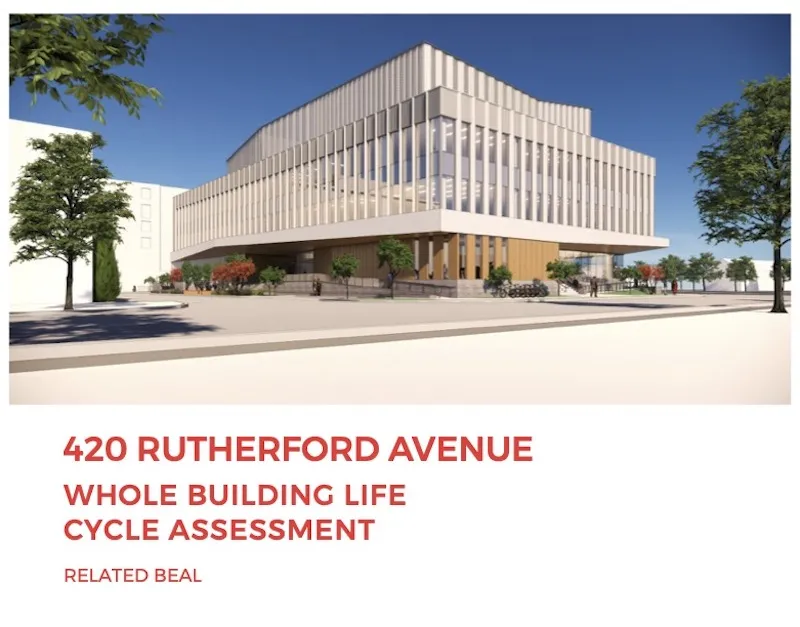
A detailed 83-page WBLCA report elucidates the process and documentation requirements.
When LEED v4 first arrived on the scene in 2013, it newly incentivized whole-building life-cycle assessment (WBLCA) that could demonstrate significant reductions in the project’s carbon footprint.
Despite a nice chunk of available points, the WBLCA option didn’t seem to get a ton of uptake. So when v4.1 rolled around, the U.S. Green Building Council (USGBC) created new entry points, introducing a tiered set of pathways: now project teams can get one point for just doing a WBLCA, even if the process doesn’t lead to significant emission reductions. The idea is to get teams and clients more comfortable with WBLCA.
Yet barriers to conducting whole-building life-cycle assessments for LEED remain—including a limited number of experts and related uncertainty about meeting LEED requirements.
To help with these issues, life-science developer Related Beal and WSP have generously shared actual documentation for a core and shell lab project pursuing v4 that substituted the v4.1 Building Life-Cycle Impact Reduction credit. (Achievement is “anticipated” after design review, which resulted in no questions or comments from reviewers.)
Premium LEEDuser subscribers can download the WBLCA samples, including a detailed 83-page LCA report, from the documentation toolkit for the v4.1 version of the credit.