
Foamglas – My New Favorite Insulation Material
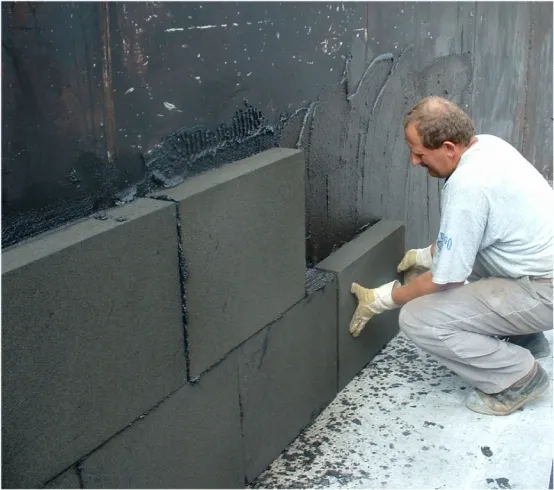
Use of Foamglas as exterior foundation insulation.
Now Foamglas is back. Axel Rebel was brought over from Europe a couple years ago to rekindle interest in the product for building insulation. As Pittsburgh Corning's vice president and general manager of the North American Building Division, I think he's going to make that happen. I met Rebel at the Building Science Corporation Westford Symposium (a.k.a. Summer Camp) a few weeks ago, and I've been getting more excited about the product ever since.
What is Foamglas?
Foamglas is a cellular glass insulation material that's impervious to moisture, inert, resistant to insects and vermin, strong, and reasonably well-insulating (R-3.44 per inch). It can be used for insulating roofs, walls, and below-grade applications, including beneath slabs. The high compressive strength makes it particularly appropriate for roof decks, green roofs, and parking decks. It is produced in 18" x 24" dimensions in thicknesses from 1-1/2" to 6" in 1/2" increments.
If you scratch a piece of Foamglas (your fingernail can cut into it), you will detect a slight rotten-egg smell from hydrogen sulfide. Iron sulfate is used in the manufacturing process, and a small amount of hydrogen sulfide is produced in the process. You don't want to breathe a lot of hydrogen sulfide, but it's locked tightly into the cellular glass--in fact, even after 30 years in place, scratching Foamglas produces the same smell. "It's proof that the cells are absolutely airtight," Rebel told me.
Features
I'm working on an in-depth product review for the October issue of Environmental Building News that will address the various performance properties and environmental attributes of Foamglas; I only touch on them here. Readers of my articles and blogs over the last few years will know that I've been critical of certain insulation materials for the flame retardants, blowing agents, formaldehyde, and other chemicals in most insulation materials.
This is where Foamglas excels. There are no blowing agents that deplete ozone or contribute to global warming. There are no flame retardants or other additives needed to improve fire resistance. As a 100% inorganic material, Foamglas is inert and fireproof. And it has enough compressive strength to be used under any concrete slab--an application where extruded polystyrene (XPS) currently dominates the market. It's better than XPS, because, in addition to the absence of those chemicals, Foamglas is totally impervious to moisture (water and vapor), does not support mold growth, blocks radon, and keeps out termites and rodents. For more on concerns with foam-plastic insulation materials, see my blogs on polystyrene and the global warming potential of insulation materials.
Cost and availability
Foamglas is more expensive than the other insulation materials we're used to using. The typical cost of Foamglas T4+ (the most common product for building insulation) is about $1.00 per board-foot, according to Rebel--roughly two-and-a-half times that of extruded polystyrene (XPS), which averages about $0.40 per board-foot. Rebel admits that if you're comparing insulation materials simply based on cost, you're not going to choose Foamglas. "We have to add another value," he told me. That value can come from replacing other layers in the construction system (vapor retarders, moisture barriers, radon-control components), from greater durability, from environmental attributes, and even from installing a thinner concrete slab. "We can reduce the thickness of the concrete slab, because Foamglas is so rigid," Rebel said.
Foamglas is manufactured at two U.S. factories and can be shipped anywhere. Most product is distributed through dozens of dealers that primarily market industrial product. Rebel told me they can even supply it for individual houses--though shipping may increase the cost. With Pittsburgh Corning looking to increase its presence in the building insulation market, and especially in green buildings, this could be a good time to try it out.
For more information:
Pittsburgh Corning Corp.
Pittsburgh, Pennsylvania
724-327-6100
www.foamglas.com