Success in achieving this credit is all about balancing building energy performance with the spatial and renewable energy resources of the site—and balancing the upfront costs of renewable energy with long-term utility bill savings.
Teams should start by identifying an energy budget to estimate the size of the system needed to achieve each credit threshold. This target could be from CBECS, the ASHRAE baseline if early modeling has been conducted, or from an energy performance target. Reducing energy consumption as much as possible will make it much easier to achieve the percentage thresholds of this credit.
Then, be sure to compare as many financial options and types of systems as possible to find what will work for the project. Don’t forget that the biggest benefit will be for the people paying the utility bills, and engage them to find the best approach. Many utilities have rebate programs that can help with financing. 
What’s New in LEED v4.1
- The unit of measure is now reduction in GHG emissions, not annual energy cost.
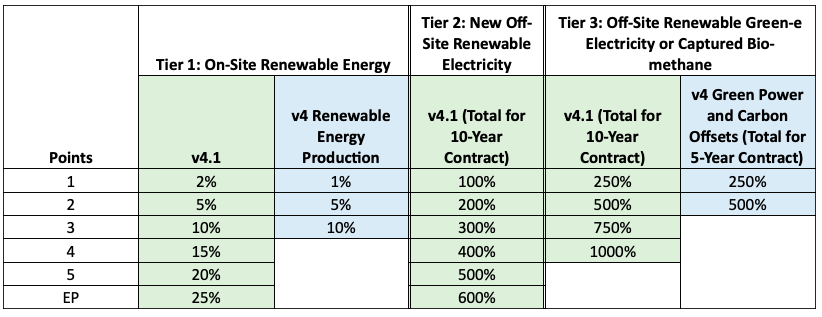
- The v4 Green Power and Carbon Offsets credit has been removed from v4.1 and replaced with an off-site renewable energy option that lives within the new Renewable Energy credit. Even though the credits have been combined, the total points available are unchanged (up to five).
Should I upgrade?
With the exception of the first point for onsite renewables, all other thresholds are now identical between v4.1 and v4 after the latest addendum. The biggest difference is the number of points available within each tier, so project teams would likely only want to upgrade if one of the following is true:
- their onsite renewable energy production exceeds 15%
- they want to purchase Tier 2 renewable electricity
- they want to purchase Tier 3 renewable electricity or captured bio-methane in excess of 750% over ten years