
LEED IEQ Space Matrix - Frequently Asked Questions
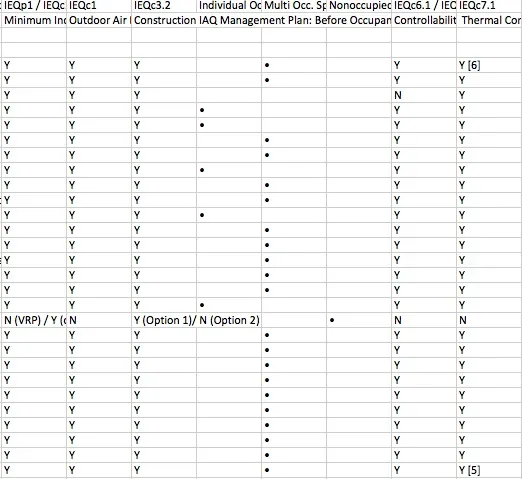
The IEQ Space Matrix, currently in its third edition as of April 1, 2015, contains lists that categorize spaces for applicability to LEED Indoor Environmental Quality (IEQ) credits. The lists are modified from the spaces in IES Lighting Handbook, 10th Edition. These lists should be used along with the general credit guidance, notes, and definitions provided in the General Credit Guidance and Notes and Definitions tabs.
Earlier editions of this spreadsheet raised more questions for some of us than they answered, but some of the frequently asked questions about the matrix have been answered with this latest release.
Note: Most of the FAQs below apply primarily to IEQc6.
Is the IEQ Space Matrix a Guidance Document or is it required?
If your project was registered after the release of the IEQ Space Matrix then LEED reviewers will expect you to use the matrix to help determine which spaces to include in various credit requirements. However, as is the case for all LEED credits, if you have an exceptional circumstance you can make a case in a narrative for why your project must take a path not outlined or clarified in the matrix.
Do only “regularly occupied spaces” or do all “occupied spaces” need to be included?
Per the IEQ Space Matrix, if a space is non-regularly occupied then it does not have to be included in IEQc6.1 or EQc6.2. The version of the matrix released 4/1/13 makes this delineation more clearly. Also, hallways and bathrooms are now officially excluded from the credit requirements.
I am working on a residential project. How many lighting controls do I need?
Per the IEQ Space Matrix, for all individual and multi-occupant spaces, each space must have one lighting control to be counted towards the credit. For IEQc6.2, each unit must have its own thermal control to be counted towards the credit. More information by room for IEQc6.1 and IEQc6.2:
- Bedrooms: Yes, need to be included in IEQc6.1 and IEQc6.2 as an individual occupant space. For this space to count towards credit for IEQc6.1 or IEQc6 (CS), one lighting control must be included in the space. For this space to count towards credit for IEQc6.2 or IEQc6 (CS), one thermal control must be located within the residential unit. The location of the control does not matter.
- Dorm Room: Yes, needs to be included in IEQc6.1 and IEQc6.2 as an individual occupant space. For this space to count towards credit for IEQc6.2 or IEQc6 (CS), one thermal control must be located within the room.
- Living: Yes, needs to be included in IEQc6.1 and IEQc6.2 as a multi-occupant space.
- Circulation/Hallways: This space is not included in the credit requirements.
- Dining: Yes, need to be included in IEQc6.1 and IEQc6.2 as a multi-occupant space. For this space to count towards credit for IEQc6.1 or IEQc6 (CS), one lighting control must be included in the space. For this space to count towards credit for IEQc6.2 or IEQc6 (CS), one thermal control must be located within the residential unit. The location of the control does not matter.
- Bathroom: This space is not included in the credit requirements.
- Workrooms: Yes, need to be included in IEQc6.1 and IEQc6.2 as a multi-occupant space. For this space to count towards credit for IEQc6.1 or IEQc6 (CS), one lighting control must be included in the space. For this space to count towards credit for IEQc6.2 or IEQc6 (CS), one thermal control must be located within the residential unit. The location of the control does not matter.
- Kitchens: Yes, need to be included in IEQc6.1 and IEQc6.2 as a multi-occupant space. For this space to count towards credit for IEQc6.1 or IEQc6 (CS), one lighting control must be included in the space. For this space to count towards credit for IEQc6.2 or IEQc6 (CS), one thermal control must be located within the residential unit. The location of the control does not matter.
- Laundry: This space is not included in the credit requirements.
- Walk-in Closets: This space is not included in the credit requirements.
I am working on a Healthcare project. How has the matrix outlined spaces for my project?
See the IEQ space matrix for a full list of rooms. Some key rooms that are to excluded include: Patient Room Bathrooms, Linen Areas, Medical Records rooms, Nursing Short Term Charting Spaces, Supply and Nutrition areas, and prep and clean up areas. Critical care areas are also excluded as an exception for the credit. Also, In-patient critical care, Pediatric, Psychiatric patient rooms can be excluded from the credit requirements. The only rooms that are considered individual occupant spaces are medical offices, nursing stations, and patient rooms. Operating rooms are still considered multi-occupant spaces.
The LEED Healthcare Reference Guide supplement also provides additional detailed guidance for space designations that is quite helpful. USGBC has not folded all of this content into the matrix.
I am working on a Hospitality project. How has the matrix outlined spaces for my project?
The Front Desk, Housekeeping areas, and lobby must be included as multi-occupant spaces. Hospitality guest rooms can be excluded from lighting and thermal control requirements.
I am working on a Retail project but not using LEED for Retail. How has the matrix outlined spaces for my project?
Retail projects not pursuing LEED for Retail, may pursue the LEED for Retail credit IEQc6 for 1 point in lieu of IEQc6.1 and IEQc6.2 for 2 points, which allows all areas except office and administrative areas to be excluded from the controls requirements.
The categories given in the IEQ space matrix don’t really fit how some of the rooms in my project will be used. What should I do?
Use your best judgment. The matrix states, “exceptions to area use classifications will be accepted on a case-by-case basis for spaces with atypical uses or those in which strategies required for compliance may compromise the function of the space. This is not an exhaustive list. If a space is not listed, project teams should try to find a similar space type and follow that guidance.”
Safety and code compliance have to always come first. You can always try writing a strong narrative to make your case for your project’s exception. However, it’s important to keep in mind that some project types may simply not be well aligned with the credit’s requirements. In that case, it might best to focus your efforts on other LEED credits that are more applicable.
I’m working on a project that has transient occupants. How does the matrix address transients, and are transients required to have access to the controls?
The matrix includes several space types that have transient occupants, for example: libraries, auditoriums, and transportation terminals. Controls must be provided for these spaces if they are listed as individual occupant or multi occupant and have the corresponding "Yes" in the relevant credit column—for example. For more on addressing controls in multi-occupant spaces, see LEEDuser's guidance on IEQc6.1 and IEQc6.2.
Your questions
Have you looked at the new IEQ Space Matrix? Post your questions and thoughts below. Also see LEEDuser's IEQ credit pages for more guidance on specific credit-by-credit requirements.