
This credit is fairly straightforward and easy to achieve if you are newly creating all the hardscapes. You may comply by applying prescriptive design measures outlined by LEED to 50% of your site’s hardscape, or by covering 50% of your project's parking spaces. If, however, your project includes a planned or existing surface parking lot, replacing the existing asphalt or finding a cost-effective alternative to new asphalt may be challenging and can make this credit difficult to achieve.
There can be added costs and labor if your project needs to modify existing hardscapes to meet the prescriptive goals of the credit: for example, taking out a black asphalt parking lot to install a more reflective material.
When dealing with existing hardscapes, it may be more cost-effective to shade areas with trees and architectural canopies, or clean and restore them to their original condition, than to replace them. This credit can be unattainable if your project’s hardscapes do not already comply and you do not have control over the design of hardscapes.
Limiting your hardscape makes it easier
Before working to treat the hardscape surfaces on your project site, don’t forget that the most effective way to reduce heat islands and help with this credit is to limit the amount of hardscape and parking spaces provided in the first place. In fact, a new interpretation allows projects that provide NO parking at all to achieve one point under this credit.
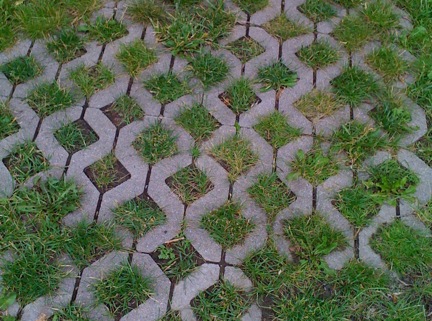 Limiting hardscape not only reduces the square footage you must treat with light-colored paving, shading, open-grid paving, or covering, it can also help you gain points under:
- SSc4.4 Alternative Transportation: Parking Capacity,
- SSc5.2: Site Development—Maximize Open Space,
- and SSc6.1 and SSc6.2: Stormwater Management.
What’s “SRI”?
The “solar reflectance index” or SRI is the measure of a surface’s ability to reflect solar heat. Higher reflectivity is desirable, because it helps combat the urban heat island effect. SRI can range from zero to over 100, with darker surfaces closer to zero and lighter surfaces approaching 100.