
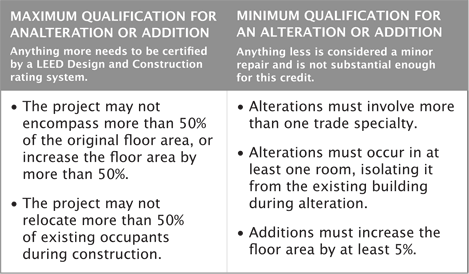
To qualify for this credit you must have facility alterations and additions take place, under the specific LEED definition, during the Performance Period. Having just one trade specialty on the job does not constitute an alteration. Be sure your project is eligible for this credit by double-checking that the work performed meets the requirements shown below under the FAQs.
Very few projects have alterations or additions planned for the performance period. Before you go too far in planning to achieve this credit, make sure your alteration or addition meets the LEED definition, and make sure the construction will take place during the performance period. See specific constraints as defined by USGBC in the table below.
Set yourself up for success
The key to this credit is establishing a foolproof system for separating and measuring the different types of waste. Construction waste from the alteration or addition must be separated from the ongoing consumables waste stream. If you can anticipate in advance what kinds of waste you are likely to generate and preemptively identify ways to divert it, you’ll be doing yourself a big favor.
You can also make it easier on yourself by making design decisions and product selections that will generate less waste. Look for products and materials that don’t have a lot of packaging, or whose manufacturers will take back the packaging or other waste to be reused.
Otherwise, the relative ease or difficulty of this credit will depend on project-specific details and regionally variable conditions:
- the timing of an eligible alteration or addition to occur during the performance period
- the types of waste the project generates
- the project’s location, local recycling infrastructure, and markets for salvaged or reusable materials in the area.
- Construction waste management (CWM) is becoming standard practice in many parts of the country, but it may be more difficult to find recyclers and salvage yards in rural or remote areas.
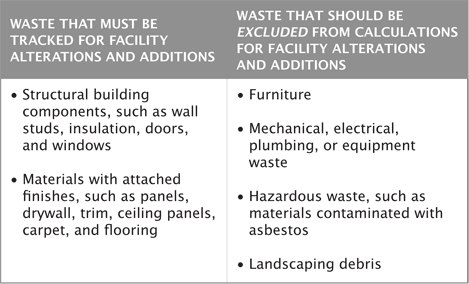
Not all waste needs to be included in the calculations
Consult the table below for the types of waste that must be tracked and those that should be excluded from your credit calculations.
Consider these questions when creating a tracking program for materials associated with facility alterations and additions:
- Is a facility alteration or addition scheduled to occur during the performance period?
- Has a waste management plan been developed for the construction?
- Is there a local market for sending waste to be recycled or salvaged? Are there organizations to which the waste can be donated?
- Can the project reuse any demolition materials?
- Are there items that can be deconstructed in a manner that allows for reuse— de-nailing 2x4 wood planks, for example?
- Does the construction team or hauler have an existing system of tracking construction waste? Can that system be repurposed to track waste in the manner required by this LEED credit?
- What are your project’s potential barriers to waste diversion?