
The intent of this credit is to reduce the amount of potable water used for flush fixtures and to minimize the amount of wastewater conveyed to the municipal system. For credit compliance, you have two options:
Option 1: Reduce the quantity of potable water used for flush fixtures (water closet and urinals only) by 50%. You have two ways to make this reduction:
- use low-flow fixtures;
- use non-potable water such as graywater or rainwater, or combine both strategies.
Option 2: Treat 50% of wastewater onsite to tertiary standards and infiltrate it, or reuse the treated wastewater onsite.
Establish a baseline
To determine your percentage reduction, compare a baseline case with the design case. Note that the baseline for WEc2 is not the same as the baseline for WEp1 and WEc3: Water Use Reduction. Whereas WEp1 and WEc3 count flow (shower, lavatory and kitchen sink) and flush fixtures (toilets and urinals), WEc2 only counts toilets and urinals. The data that you enter on flush fixtures in the LEED Online credit form in WEp1 will automatically populate the credit form for WEc2.
The calculations for wastewater use are based on the number of full-time equivalent (FTE) occupants. FTE calculations can sometimes be confusing in certain building types or occupancy types—see WEp1 for more information.
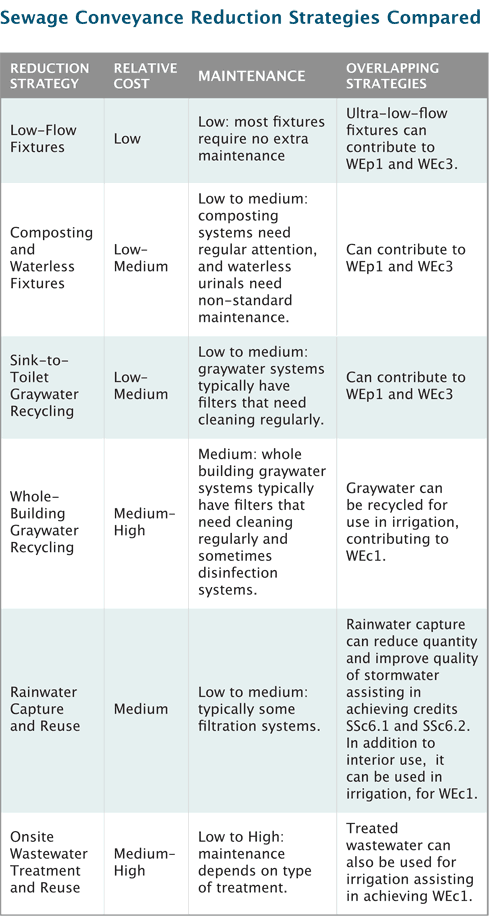 Fixture choice is the cheapest option, if you can make it work
Generally, the easiest and cheapest way to achieve this credit is to install low-flow and waterless fixtures. Using waterless urinals or pint-per-flush urinals in combination with ultra-low-flow toilets (1.0 gpf) or aggressive, dual-flush toilets (1.28/0.8 gpf) can work, although it depends on your project occupancy and will need to be verified for each project.
If your project comes up just a little short, consider supplementing some of your potable water use with graywater or rainwater, or installing composting toilets.
Treating wastewater onsite is great—if it’s right for your project
Onsite wastewater treatment has a number of environmental and educational benefits, but treating to tertiary standards can be challenging for some projects, especially if they have limited space. The Solaire, a LEED Gold market-rate apartment building in Battery Park City in Manhattan, located wastewater treatment facilities in the basement because above-grade space was at a premium.
Treating to tertiary standards involves extra filtration or biological activity to remove nutrient pollutants such as nitrogen and phosphorus, and it may also involve disinfection. Treating wastewater to this level goes beyond code in most places. Consider technologies that are passive or low-tech in order to minimize operation and maintenance costs.
Once the wastewater has been treated to tertiary standards, you’ll need to determine the best reuse method. Many projects prefer to use it landscape irrigation. This will generally be your cheapest and easiest reuse method. If your project doesn’t have landscaping, consider reusing the treated wastewater for toilet flushing.
Notes on specific building types
Office—In order for office spaces or other buildings to meet the credit through fixtures alone, they will most likely need to include waterless urinals. (Depending on your project, one-pint-flush urinals may work.)
Multifamily and Hotel—Residential and hotel projects, which don’t have urinals in private bathrooms, cannot meet this credit with low-flush fixtures alone, so they have to provide nonpotable water or treat wastewater on site to earn the credit.