
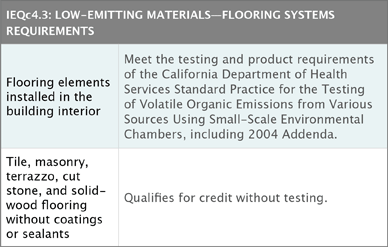
 The simplest way to meet this credit is to make sure that all your flooring and floor coverings meet the standard designated in the credit requirements. That’s not necessarily easy, because not that many hard-surface flooring products are FloorScore-certified or the equivalent.
It’s easier to achieve this credit if all your regularly occupied spaces are carpeted, because compliant carpet is readily available at no cost premium. Carpet is less durable than hard-surface flooring, though, so may not be the best choice in all spaces.
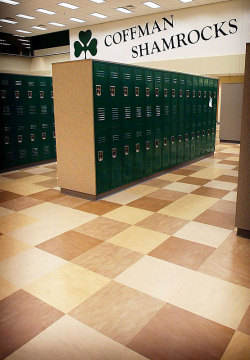
Resilient flooring, rubber flooring, and prefinished wood flooring all must be FloorScore or Greenguard Gold certified. Wood, concrete, ceramic tile and other flooring installed without coatings need not be certified as long all coatings and finished applied to them meet the requirements of IEQc4.2: Low-Emitting Materials—Paints and Coatings.
USGBC put out LEED-NC EQc4.3 requirements rather than the more stringent LEED-for-Schools requirements. This options applies to adhesives and coatings used as well.
Credit changes
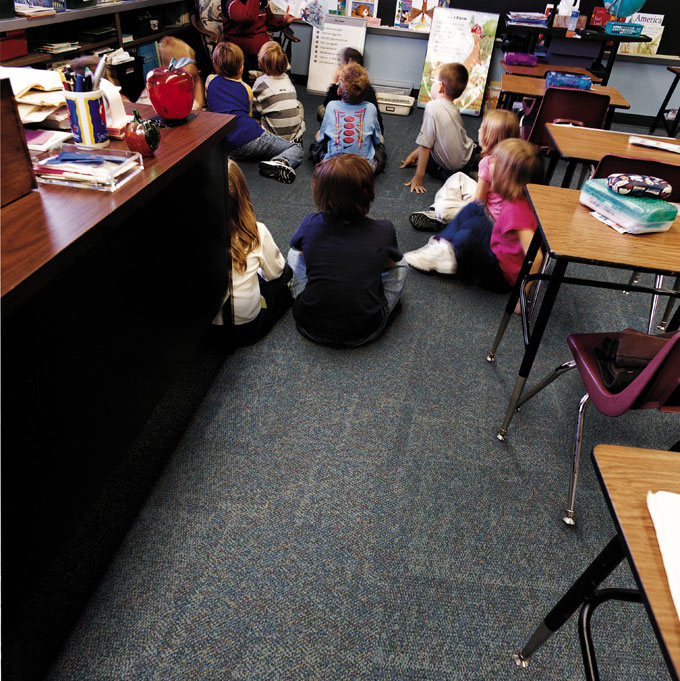 This credit represents a significant change from past versions of LEED, which focused on just carpeting. LEED 2009 now mandates low-emitting standards for pretty much any kind of flooring. To be eligible to attempt this credit at least 25% of the finished floor area (carpet and non-carpet) must use low-emitting products. Installing a small patch of compliant flooring no longer qualifies for the credit. To earn the credit, 100% of both carpeted and non-carpeted finished floors must be low-emitting.
Both designers and contractors have to understand the rules
While this is a construction-phase credit—and the contractor will need to ensure that VOC-compliant adhesives, sealants and coatings have been applied to flooring systems—it can be dealt with primarily during the design phase by choosing specific manufacturers and flooring products for the contractor to use. Allocating adequate time for product research, and identifying compliant flooring products before construction begins, help ensure that the right products are used.
Make sure the contractor and subcontractors know what information to look for. Don’t allow them to use products that merely claim to be low-emitting. Find the manufacturer’s data stating that its flooring systems have been tested by an accredited lab and complies with the California Department of Health Services protocol. Greenguard Children and Schools program—but not the generic Greenguard program—meets this protocol. (See Resources.)
You’ll have to document flooring adhesives, sealants, paints, and coatings twice—once for IEQc4.1 or IEQc4.2, and again for this credit. Enter the same VOC data for flooring adhesives, sealants, and coatings in the LEED forms for IEQc4.1, IEQc4.2 and IEQc4.3.
 Only 20% of product cut sheets selected at random need to be uploaded to LEED Online to document this credit although it is best to keep all product cut sheets on file in case the credit is audited.