
You will not earn this prerequisite using standard fixtures that only comply with the federal EPAct 1992. This prerequisite, first introduced in LEED 2009, raises the bar significantly. All projects must now reduce water use by at least 20% as a prerequisite, whereas earlier versions of LEED awarded a point for a 20% reduction. The baseline against which water savings are measured has also become more demanding. The LEED 2009 baseline for commercial lavatory faucets is 0.5 gallons per minute (gpm), whereas the previous baseline was 2.5 gpm. Note that this prerequisite addresses interior water use only, but can be coupled with other water credits addressing outdoor water use.
Plan on focusing on efficiency with ultra-low-flow or waterless fixtures, as well as overall conservation with strategies like rainwater capture and graywater reuse (these strategies are documented as an alternative compliance path in LEED Online). Careful attention to fixture selection and flow rates can help projects achieve 20% or greater interior water savings at minimal cost and without compromising comfort.
Clearly defining Fixture Usage Groups is an important step in achieving this credit. In buildings with toilet facilities that are not accessible to visitors, it is reasonable to exclude visitor numbers from the Fixture Usage Groups. The occupancy values entered in the PI forms should inform, but not necessarily parallel the numbers used for this credit.
Follow these key steps
- Determine Full Time Equivalent (FTE) occupancy and Fixture Usage Groups.
- Determine the Baseline Case Water Use Budget for Indoor Water Use.
- Choose fixtures and water reduction or reuse strategies.
- Estimate the project’s water usage by creating a Design Case Water Use Budget.
- Use the LEED Online credit form to compare the baseline and design case water budgets to determine the water reduction percentage for the project.
- Complete the LEED Online credit form and upload water fixture cut sheets.
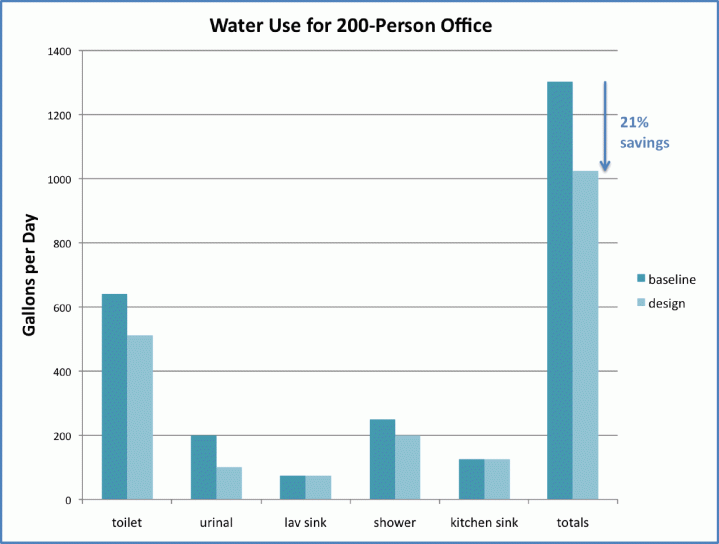
In the example illustrated in this bar chart, 21% savings is achieved by looking for savings in the fixtures that use the most volume of water: toilets, urinals, and showers. This example assumes 1.28 gpf toilets, 0.5 gpf urinals, and 2.0 gpm showers. Sinks are a less likely target because baseline use is already very low in many cases.
Only some water uses are under the LEED scope
Project teams often assume that if a water fixture or process on their project uses water, then it must fall under the scope of this credit. However, only specific "regulated" fixtures fall under the scope. The following uses, among others, are not within the credit scope. Following efficient practices is a great idea for these uses, but it's simply not covered under the scope here.
- "Process" water
- Pot- or bucket-filling sinks
- Bidets
- Laboratory sinks
- Dishwashers and other appliances
Key guidance from USGBC
Since LEED 2009 was launched, USGBC has developed and updated a key guidance document for WEp1 calculations: Water Use Reduction Additional Guidance. It provides indispensable guidance for fixture groups, total daily uses calculation, dual flush toilet flow rates, public metering faucet flow rate conversion, non-potable water use alternative compliance path and gender ratio guidance.
For example, this document provides key guidance on when a non-default male-female gender ratio is appropriate—essentially, modifications to the 50:50 ratio must be shown to apply for the life of the building, with specific exceptions allowed.