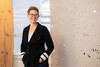
I wanted to share some thoughts from Brenda Stanfield about the Design for Freedom conference and the work that she is doing to fight the difficult problem of forced and child labor in construction materials.I feel like it is a step up from the LEED social justice pilot credits, which are a great start. Hopefully it helps you in your work. I am also attaching the social justice labels that I developed with Brenda. Please feel free to use them in your libraries.
From Brenda:
I attended the Design For Freedom Summit late last month (as did Chris and Doug). The most important thought I took away was a sense of urgency to address the issues of forced and child labor in our industry—and what each of us can do and has a responsibility to do.
Within the opening remarks the fact that there are 50 million enslaved individuals around the world, 70% of whom are women, was a staggering number to comprehend, but as the speaker events progressed through the day, it became easier to understand how this is happening.
We must be the messengers to convey to all our manufacturers that we are paying attention and we want them to work toward reducing any and all unacceptable labor practices throughout their entire supply chains, from raw material extraction through manufacturing. Eventually we will be requiring proof from the manufacturers whose products we specify to “prove” that there is no forced or child labor throughout their supply chains. Few have proof of this now, but it is a growing awareness and we can increase the awareness exponentially by simply asking the questions.
Several months ago I began asking these simple questions of each of the reps I met with. In some of the libraries we manage, including yours, we are attaching our “social justice” labels to materials we believe do have proof—based on certifications noted below. Reps see this label and ask how their company’s products can have it too. So, simply by asking questions and pointing out our social justice labels, we are having good conversations and hopefully each of them will carry the questions back to their leadership that can begin to address the issues.
These are the questions I ask:
• Where are your products manufactured?
• What is your company doing to ensure along their entire supply chain that there is no forced or child labor involved?
• Does your company have clear written policies for all their labor practices?
• If your company attests to good, fair working conditions along their entire supply chain (and many manufacturers now have statements on their websites to say as much), can it be proven? Do they have 3rd party monitors?
• Can you provide us with “certified statements” (by 3rd parties) that verify your company’s labor practices?
For the most part, the answers will be vague or “don’t know, but I’ll see if I can find out”. If they ask about certifications, these are the ones we are using currently to understand the manufacturers that have “earned” the social justice labels:
• Cradle2Cradle 3.1 Silver or above with a Gold score in the social fairness category
• Just certification with the ILFI
• Certified BCorp
• Mfgs who have signed on to the UN Global Compact
• NSC373 for natural stones
• GreenSquared Certified for porcelain & ceramic tile
• FSC Certified
• SA8000 (so far only Forbo has this one)—it is a Standard for Social Accountability
• Aluminum Stewardship Initiative
Other certifications we have to understand more about before we decide they comply, are
Concrete Sustainability Council Certification
The Copper Mark
Fair Stone
Global GreenTag
BIFMA Level III
Responsible Steel Certification
Sustainable Forestry Initiative
That’s all I’ve got for now.
Brenda
Brenda Stanfield, AIA, LEED AP BD+C
Building & Design Resources
Cambridge, MA