
What Type of Insulation Should You Use?
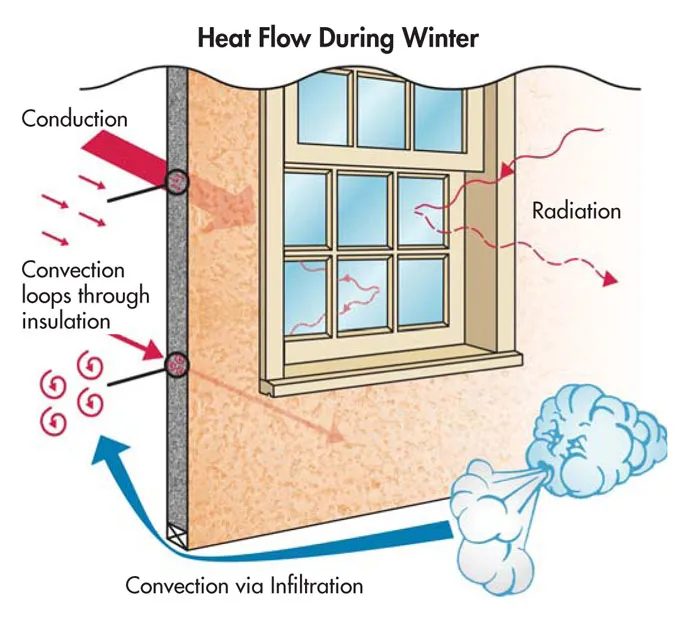
Heat moves through our walls, roofs, and floors in three ways: our insulation and air sealing materials must contend with all three at once.
Part 1: The Basics
Click to Read Part 2: Identifying Your Priorities
Choosing the best insulation to maximize performance and minimize environmental impacts is one of the most complex decisions you can make for a building project.
Insulation is a critical component of any building--especially one designed and built to minimize environmental impacts.
Determining what type of insulation to install--and how much of it--can be complex. No other building product category offers such a diverse range of materials and impacts to consider: environmental, human health, performance, and building science.
Moreover, on top of the wide range of existing insulation products, new insulation materials and new variations of older insulation materials are appearing regularly. For example, in addition to standard fiberglass, cellulose, polystyrene, and polyisocyanurate insulation, we can now purchase insulation made from mineral wool, cementitious foam, radiant foil, cellular glass, vacuum panels, gas-filled panels, wool, recycled cotton, and polyester.
With such a diverse range of materials--and material properties--from which to choose, selecting the best insulation for a given application can be tremendously confusing.
GreenSpec is here with the information you need to make the correct decision for your project's needs and budget. Take GreenSpec's insulation quiz and learn how to make the right insulation choices.
How Insulation Works
To understand insulation materials, one needs to understand the basics of heat flow.
There are three primary mechanisms of heat flow: conduction, convection, and radiation.
Thermal conduction is the movement of heat from direct contact: one molecule is activated (excited) by heat and transfers that kinetic energy to an adjacent molecule.
We generally think of conduction occurring between solid materials--the handle of a hot skillet conducting its heat to your hand, for example--and that is the most efficient mode of conduction. Thermal conduction also occurs within liquids and gases, but more slowly.
Convection is the transfer of heat in liquids and gases by the physical movement of those molecules from one place to another. As air is warmed, it expands, becomes more buoyant, and rises--a process called natural convection. This occurs with liquids, too, as we experience with thermosiphon solar water heaters.
Finally, radiation is the transfer of heat from the surfaces of one body to another via the propagation of electromagnetic waves. When you sit in front of a fireplace and look into the fire, your face is warmed by the radiant transfer of energy from that heat source to your face. That radiant energy is not affected by air currents and occurs even across a vacuum--as we know from lying in the sun and experiencing radiant energy that has traveled 93 million miles through space.
Here on Earth, heat flow is almost always moving in all three modes simultaneously, and our insulation must reckon with that.
In Part II of this series, we'll discuss some of the thorniest questions building professionals confront when selecting insulation.
In preparation, be sure to test your basic knowledge of insulation materials by taking GreenSpec's insulation quiz.