
USA Today Story on LEED Misses the Mark
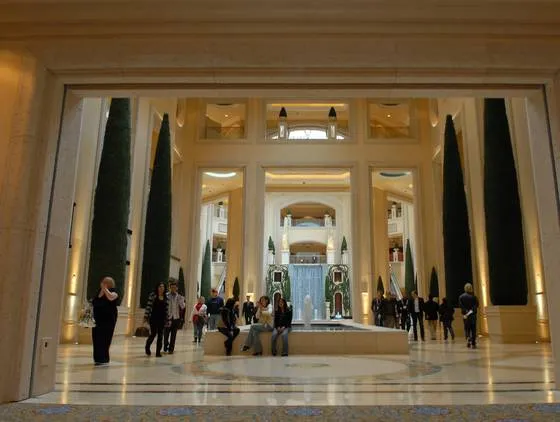
The LEED-certified Palazzo in Las Vegas
I took a call from Tom Frank, a reporter at USA Today last week, and spent over an hour on the phone with him explaining the proposed LEED v4 rating system and what it’s trying to achieve. I wish I had saved my breath, because the story that came out today used almost nothing from our conversation, and instead devotes itself to attacking LEED based not on the future, but on ancient (2002–2008) history.
The story casts LEED as a tool developers use to garner tax breaks and other advantages for very little environmental or social benefit. It’s true that some projects have exploited loopholes in LEED requirements and achieved credits for measures that they either had to do anyway, or did for no good reason except to earn the point. Each new version of LEED has gotten a little more sophisticated in removing those loopholes, so that’s happening less than it used to, but the long lag-time between registering a project and earning certification means that it takes a while for those improvements to filter through.
The USA Today story features the Palazzo Hotel and Casino in Las Vegas, which was certified in 2008 based on a version of the LEED rating system that was released in 2002. Yes, it earned points for some silly things, and won huge tax credits (as we wrote in “Navigating Incentives and Regulations for Green Building” the Nevada law providing those credits was poorly conceived and quickly rescinded). But further, USA Today acknowledges that the team behind the Palazzo also did some pretty important things, such as solar-heating the swimming pools and using occupancy sensors to control ventilation to hotel rooms.
What the article never does is look at the whole picture: either for individual projects or the industry as a whole. Is it a problem that projects earn some low-benefit points if LEED also causes them to take more meaningful measures?
Government Mandates and Incentives
Much of the story’s attack on LEED is based on how it is used by governments at various levels to mandate or provide incentives for green building. It’s no secret that LEED is not a great tool for that purpose, which is why USGBC, ASHRAE, and AIA have worked so hard on Standard 189 and the International Green Construction Code (IgCC). Now that those resources are available LEED can focus on what it was created to do, which is to provide a framework for green building and spur voluntary, market-based incentives to go beyond code.
Does the Cost of Points Matter?
The author also gets sucked into the red herring of cost, accusing LEED of giving developers credit for doing things that have low or no cost.
The goal of LEED, as far as I’m concerned, is not to get owners to spend a ton of money investing in green technology, but to encourage them to do stuff that provides real environmental and social benefit, regardless of what that stuff costs. If a green measure doesn’t cost much, but most building projects aren’t using it, then LEED has a useful role to play in educating projects about that measure. We highlight lower-cost credit like IEQc4.2 on LEEDuser, and the story quotes LEEDuser’s suggestions as if low-hanging fruit were a sin.
(This is also a case of damned if you do, damned if you don’t: LEED v4 has been protested by some industry groups based in part on credits that could push products to implement measures that would cost building projects more and potentially—hopefully, in fact—push product manufacturers out of their comfortable business-as-usual zones.)
Existing Buildings Don’t Exist?
The article’s biggest flaw, however, is the way it ignores LEED for Existing Buildings: Operations & Maintenance (EBOM) entirely. I agree that there are problems with awarding certification based on the promise of green performance—it would have been nice if USGBC had taken the suggestion that I (and others) made back in 2008 to change the certification for Building Design + Construction projects to something like “Built for LEED.” But the way the article attacks LEED on that performance gap without even mentioning the EBOM rating system that is based entirely on performance is selective use of data more typical of a political campaign than good journalism. (Tom Frank, the author of the USA Today article, defended this choice in an email to me, pointing out that his focus was on government programs that rely mostly on LEED for New Construction.)
Fortunately, USGBC also recognized the performance gap with its Design + Construction rating systems (such as LEED-NC), and is taking increasingly ambitious steps to close that gap, with everything from improved guidelines for energy modeling to mandatory reporting requirements, and increasing incentives for teams to recertify regularly based on their actual performance.
Disconnected Messages
Buried deep in the article are some quotes strongly supportive of LEED, which seem out of place as the article makes no effort to explain why the smart people behind those quotes believe what they say if LEED is the sham the article says it is.
Given the amount of work that apparently went into this story, and the valid concerns it raises, it’s too bad that it ended up so flawed, missing a chance to raise the quality of discourse on more important and relevant questions about LEED and green building generally.
Did you see the USA Today article? What did you think? Post your comments below.