
The Global Warming Potential of Insulation Materials – New Calculator
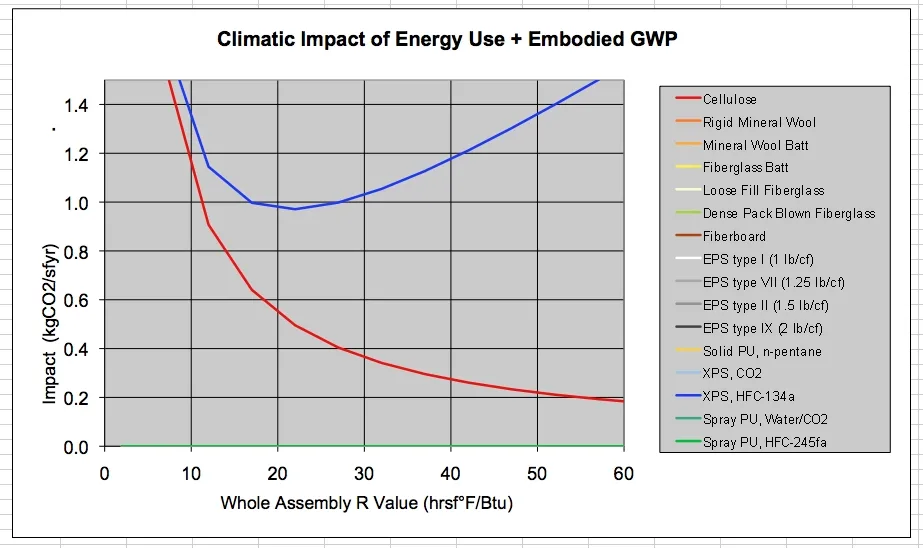
A sample output from David White's Insulation GWP Tool. See details below on how this works.
In the June issue of Environmental Building News last year, we published one of those slap-in-the-face, wake-up-call articles that forces people to rethink conventional wisdom. Most of us had long thought that more insulation was almost always better in saving energy and reducing greenhouse gas emissions. After all, the more insulation we install, the less energy gets used in the building and the less carbon dioxide is emitted.
What we long overlooked in this assumption is the very high global warming potential (GWP) of the blowing agents used in certain insulation materials. When we use foam insulation made with HFC blowing agents--specifically extruded polystyrene and closed-cell spray polyurethane foam--the more-is-better argument gets thrown out the window. That's what that EBN article, "Avoiding the Global Warming Impacts of Insulation," was about. The key points were covered in a widely read follow-up blog that's available to non-subscribers. When I wrote that article and produced the original charts on the GWP "payback" for these insulation materials (with help from Daniel Bergey and John Straube at Building Science Corporation), I had to make a lot of assumptions: how much blowing agent is released, where the building is located, the starting R-value of the building enclosure, efficiency of heating equipment, and so forth. The results got the idea across, but they had a lot of limitations.
Enter David White, a Passive House consultant from Brooklyn, New York. His company, Right Environments, has been developing some cutting-edge Passive House projects in New York City. He is also a deep thinker--and great with numbers.
David took the basic mathematical framework of the analysis we had done and packaged that into a sophisticated Excel spreadsheet that allows the user to modify variables and look at a bunch of different insulation materials. Clear graphs are produced that make it easy to draw conclusions from the information. It's an amazing calculator. And, thanks to David, we're making it available at no cost on our website.
The Insulation GWP Tool graphs show that with most insulation materials, there are diminishing benefits of added insulation thickness (or R-value), but more insulation still reduces total GWP. (It is the embodied energy of producing that insulation that results in this diminishing benefit.) With extruded polystyrene (XPS) and standard closed-cell spray polyurethane foam (SPF), however, the graphs show very clearly how adding more insulation can significantly worsen the global warming profile of the insulation.
In creating this calculator, David (with a little help from professor Danny Harvey, who wrote the original journal article that brought this concern to our attention, John Straube, myself, and several in the chemical industry) dug deeply into the underlying assumptions about how much blowing agent is used in these insulation materials, what happens to the blowing agent over time, and various performance issues. Because the results are influenced significantly by assumptions on how quickly the blowing agents will be lost from the insulation--and because we don't really have good answers about this--the calculator allows you to change those assumptions.
The calculator provides lots of flexibility. If you'd rather work in metric than inch-pound (I-P) units, no problem; there's a separate worksheet for each. Pay particular attention to the first sheet, which explains how the calculator works, and provides notes.
The example shown here gives a sense of how this calculator can inform decision-making. Two different insulation materials are compared: XPS and cellulose. You can select and deselect insulation materials to include or exclude them from the results. On the x-axis is shown whole-wall R-values, from zero at the left side to R-60 on the far right. On the y-axis is shown greenhouse gas emissions in kilograms of carbon dioxide equivalent per square foot (don't worry about those units). We can see that as the amount of cellulose in the wall increases (higher R-value) the total greenhouse gas emissions of the wall-assembly drops. So, relative to global warming potential, the more insulation the better--at least up to R-60 (given the assumptions we plugged in to the calculator).
With XPS, though, the results are very different. Increasing the R-value reduces total greenhouse gas emissions only up to about R-20, with these assumptions. This means that if your goal is to reduce the risk of global warming, then adding much more than about 4 inches of XPS doesn't make sense--again, given the assumptions. Even in adding that R-20 does much better, relative to GWP, if we use a different insulation material--as can be seen by selecting different insulation materials. If we double the life of the insulation (building) to 100 years, the XPS does better--because there's more time to amortize the embodied GWP. If we assume the building is in a colder climate (say 9,000 degree days) or is using a less efficient heating system, more XPS will also be better, while if the climate is warmer (say 4,000 degree-days), the XPS looks worse. If we increase the "starting" R-value (assuming, say R-18 with cavity-fill insulation in a 2x6 wall), it will only make sense to add about an inch of XPS (with the default assumptions for climate, heating system efficiency, and such). In the calculator, you can change only the cells highlighted in yellow; others are fixed.
You can download the Insulation GWP Tool here. Be aware that it uses macros. With Excel 2008 for Mac, these macros do not work at all (nor do any macros). With all other versions of Excel, you may need to change your macro security level (under Tools: Options: Security) to "Medium" to allow these macros to work. They are not necessary for the tool to work properly, they are just to help you quickly set the chart's scales.
We would like to continuously improve this tool, so please let us know of any bugs you find or recommendations for enhancements you have--using the comments field below. What would make this more useful to you?