
Getting to Know Spider Insulation
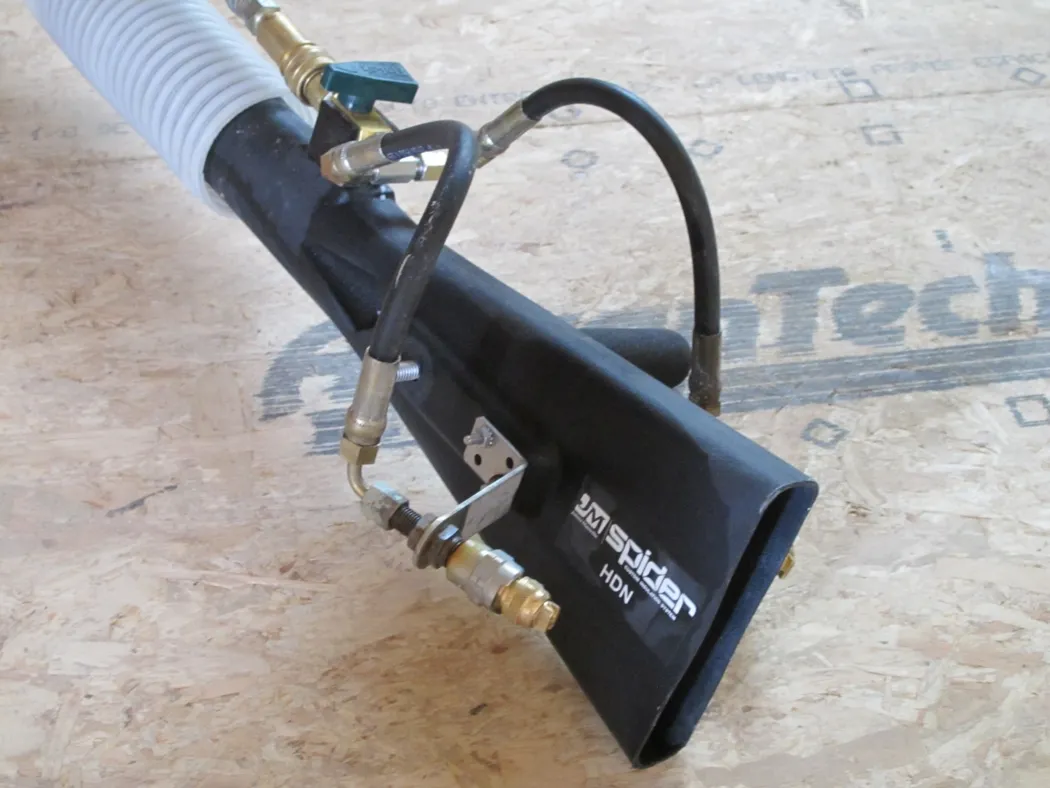
The spray nozzle coats the fibers with an acrylic binder as they exit the nozzle.
We’ve just completed the installation of a relatively new and (at least in New England) little-known insulation material called Spider. As a reminder, the house we are renovating (really re-building) in Dummerston, Vermont has provided an opportunity to try out dozens of innovative products and materials that I’ve long researched and written about in Environmental Building News.
Insulation has been a particular focus of the project, in part because some of the most common insulation materials on the market have environmental or health concerns, including halogenated flame retardants and blowing agents that contribute significantly to global warming.
In previous blogs I described Foamglas, a cellular-glass material, that we installed under the foundation slab and on the outside of the foundation walls, and expanded-cork boardstock insulation that we installed on the outside of above-grade walls spanning over the wood framing. Here I’m covering the third innovative insulation product we used on the project: a spray-applied fiberglass product made by the Johns Manville Company called Spider.
Spray-applied insulation that doesn’t require netting
Spider insulation is installed into open wall and ceiling cavities in much the same way that damp-spray (or wet-spray) cellulose is installed. Like cellulose, it fills very well around wires, penetrations, and any irregularities in the wall cavity—it performs far better than fiberglass batts, which I think should only be considered on very small jobs where bringing in an insulation contractor can’t be justified.
The fiber insulation is sprayed from the truck and as it is blown into the wall or ceiling cavity the fibers are coated with a small amount of acrylic binder. That makes the fibers sticky (thus the name “Spider”) so they stay in the cavities. It even works in overhead cavities, where netting is required with cellulose.
As with damp-spray cellulose, the cavities are over-filled, then the excess is trimmed flush with the inner face of the studs or rafters. This is done with a special “scrubbing” or “screeding” tool, which has a wide, electric roller that spans two studs or rafters.
As Spider is installed, a second worker vacuums up the material that doesn’t stick to the cavity or is scrubbed off, and this goes back into a hopper in the truck. With the most advanced installation equipment, as was used on our project by Environmental Foam of Vermont, the recovered insulation is mixed with virgin material at a ratio that can be adjusted. For overhead blowing into cathedral ceilings, a higher proportion of virgin insulation is recommended for better adherence, while a higher proportion of the recovered insulation can be used in walls.
Comparisons with cellulose
I have long been a fan of cellulose insulation, and I have actively promoted it over the years. But spray-applied fiberglass has some advantages that I came to appreciate while working with and chatting with the installers.
While cellulose has higher recycled content (about 80%—the rest being flame retardant, usually borates), Spider has reasonable recycled content: 20% post-consumer and 5% pre-consumer recycled glass.
Spider goes in at significantly lower density: typically 1.8 pounds per cubic foot (pcf), while cellulose is typically installed at 3.5 to 4.0 pcf. For our cathedral ceiling application, we were worried that the 15” insulation depth would be so heavy with cellulose that it would cause the drywall to bow inward between the strapping.
The insulating value is slightly higher with Spider: R-4.2 vs. 3.7 to 3.8 for dense-pack or damp-spray cellulose.
Acoustic performance is similar; both work very well at blocking noise. According to Johns Manville, Spider installed in a 2x4 exterior wall, with 1/2” particleboard siding, 1/8” pressed-cardboard sheathing, and 1/2” drywall, provides an STC (sound transmission class) rating of 43, which is much higher than a comparable wall with fiberglass batt insulation and somewhat higher than a wall with cellulose.
Fiberglass is an inorganic fiber, so if it gets wet it may dry out better than cellulose—though you don’t want any fiber insulation material to get wet.
From a health standpoint, cellulose and Spider are both made without formaldehyde, but Spider doesn’t require a flame retardant, while cellulose does. While the borate flame retardants used in cellulose have always been considered safe for humans, the Europeans have recently challenged that contention, and those chemicals are being considered for addition to the European REACH program. There has in the past been concern about respirable glass fibers potentially being carcinogenic, but this concern has largely disappeared, and with Spider few fibers seem become airborne.
Spider installation is far less dusty than cellulose. I was working in the house during most of the two-day installation, and I was amazed how little insulation was in the air. I wore a dust mask, but was otherwise unprotected. My arms and eyes didn’t get at all itchy, as they do when I have installed fiberglass batts. The installers were wearing shorts and tell me that they experience no itchiness.
For our installer, Kent Burgess of Burlington-based Environmental Foam of Vermont (an insulation contractor who installs a wide variety of insulation materials, despite the name), one of the biggest advantages over cellulose is that he can fit about two-and-a-half times as much of the bagged material into his truck than with cellulose. This is mostly because it goes in at a lower density, but I think the packed bags are also more dense. For a large job this can mean avoiding the need to return to home base to fill up with bags of material.
Kent used to install a lot of cellulose, but he far prefers Spider now. He is fairly new to Spider—having purchased equipment only last fall—so he was able to convince his mentor, Kyle Novak, of Advanced Insulation Systems in Travers City, Michigan to make the 12-hour drive east to help out of our job. The deep, sloped-ceiling application was tricky, and Kyle’s experience would be invaluable, since he has been installing Spider since early 2006, not long after it was introduced to the market.
Cost and performance
Kent says that Spider averages about 10% more expensive than damp-spray cellulose, but costs have a lot to do with the size of the project and the distance traveled. For a project further from his home base, using Spider can avoid the need for a return trip to pick up more material. In that case, Spider will be significantly less expensive.
Kent says the price of installed Spider averages about $1.50 to $1.65 per square foot for a 2x6 wall, or roughly 28-30¢ per board-foot, vs. maybe 24¢ per board-foot for cellulose. A quality closed-cell spray polyurethane foam (SPF) job will cost 80¢ to $1.00 per board foot for a large job, and with SPF there is the issue of how much can be installed at a time (because the curing is an exothermic reaction, and the foam heats up). Plus, Spider is a lot safer; supplied-air respirators aren’t needed with Spider, while they are with SPF.
The drawback is the cost of getting set up to install Spider. Kent has about $70,000 invested in the equipment.
In the seven years Kyle has been installing Spider he’s had no real problems. “I think it’s the greatest thing on the face of the Earth,” Kyle told me after spending a day-and-a-half spraying the material. “It doesn’t settle,” he said, and customers love the look of the finished job.
When Kyle has gone back into houses insulated with Spider to do repairs or additions and opened up walls, he has seen absolutely no problems.
For cavity-insulation applications, Spider is a great option. Cellulose is also a great product, but for deep installations and sloped ceilings, I don’t think anything beats Spider today. Fiberglass batts aren’t even in contention.
Alex is founder of BuildingGreen, Inc. and executive editor of Environmental Building News. In 2012 he founded the Resilient Design Institute. To keep up with Alex’s latest articles and musings, you can sign up for his Twitter feed.