
Dear USGBC, Give Us Transparency on LEED Energy Data
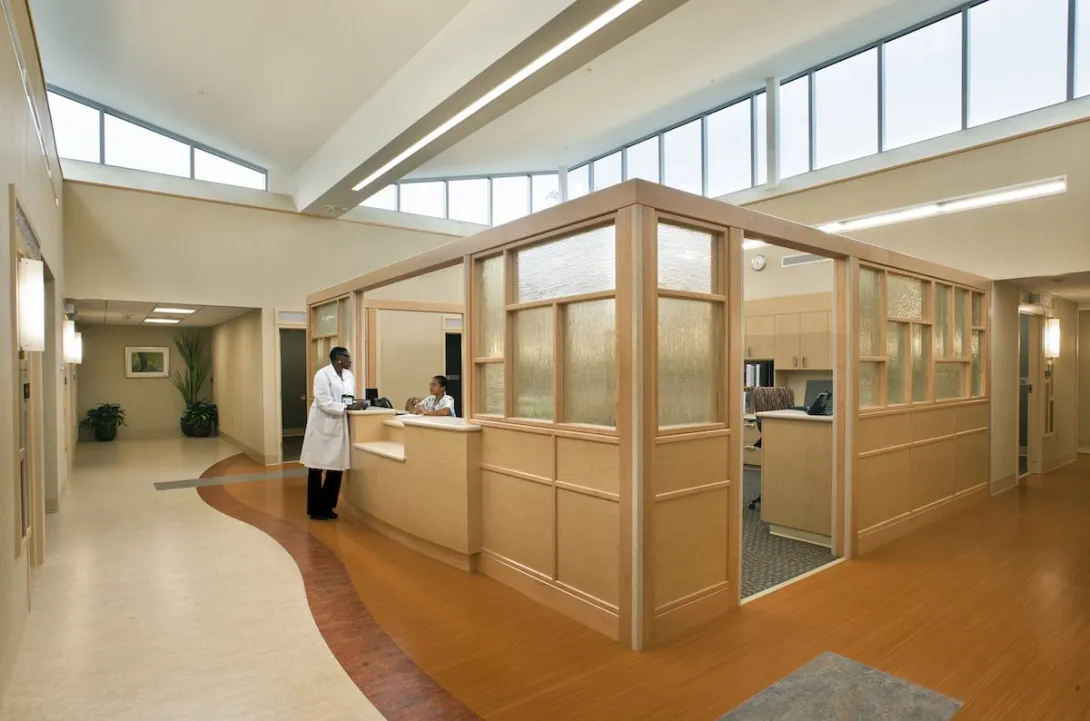
Designed by Wilmot Sanz, the Sibley Radiation Oncology Facility in Washington, D.C., on track for Silver certification under LEED 2009, is one of thousands of buildings that is or will be putting energy and water data into the MPR6 pipeline opened by USGBC.
Dear USGBC,
For the last year, as the transparency and disclosure movement has gained steam in the building products industry, we’ve heard many compelling arguments for why manufacturers should be transparent about what’s in their products. From USGBC representatives and members, we’ve heard that:
- Designers armed with more information will be empowered to make better decisions on behalf of their projects. We need “nutrition labels” for building products.
- It’s okay not to be perfect. The act of disclosure, of looking at what’s in your product, will lead to its own insights. The industry understands that making things involves tradeoffs and that self-awareness leads to self-improvement.
- Participation matters. One of the biggest players in transparency has “collaborative” right in its name (the Health Product Declaration Collaborative). As we have reported, industry leaders have been fair in giving competitive programs a chance. Whatever happens on the field, we’re glad that various stakeholders are showing up to play.
It’s time for USGBC to walk the walk when it comes to energy data from LEED buildings.
We’ve made progress since 2008
A lot of people in the LEED community felt pained by the second-guessing and lawsuits that followed the 2008 New Buildings Institute study. The limitations of that data set made them a target for anyone with an agenda against LEED who wanted to make a point. We looked at the arguments and gave you the benefit of the doubt. Transparency wasn’t the buzzword yet, but it was in the air, and anyway, more data would be coming soon!
With the release of LEED 2009, you added Minimum Program Requirement #6 (MPR6), requiring energy and water data reporting for LEED buildings. You took a risk here, exhibiting leadership. A lot of people said that MPR6 was going to turn off owners, even after you promised that it wouldn't lead to plaques being ripped from buildings, and you stated that only aggregated, anonymized data would be released as a result. (Your official policy on MPR6 also stated—and still states—that data would be released regularly.)
We’ve come a long way since then. In LEED 2009, you could sidestep the MPR6 reporting requirement by saying that your building isn’t metered. Now, in LEED v4, energy meters are a prerequisite in the credit language, and through the public comment process we didn’t hear a lot of complaint about this. Perhaps that’s because things have come so far in other parts of the industry. New York City is releasing data on its big buildings, never mind concerns about anonymity. Other major cities are taking similar steps.
You’ve also moved forward with the LEED Dynamic Plaque, a cool gadget that will show real-time LEED performance of a building to anyone who wants to see. The trouble is, the Dynamic Plaque is still a black box to most of us. What algorithms drive it? How long will it take for it to reach the majority of LEED buildings, and will it be a useful too both for individual building owners and for those of us looking at LEED’s overall performance?
Transparency rules
It looks as if you don’t want to reveal any chinks in your armor. It’s a tough political and economic environment out there for LEED, and you rightly want to stay focused on transforming the market. We support you in that goal, but LEED is still accountable for its record. Transparency rules right now, and we want to know what has become of that MPR6 data. The release in 2012 was a red herring: it made sweeping statements about LEED buildings, and only in the fine print did we learn that it was based on a small sample of existing buildings, not representing a wide swath of LEED.
The latest release is potentially more exciting—data from almost 1,900 buildings, the largest release of LEED energy data yet, by far! Unfortunately, as I wrote in our reporting on this release, USGBC members are only getting a sliver of information out of it: an average metric from 450 buildings, and we don’t have the most basic information about size, type, and rating system. We’d also like to know how many buildings claimed exemptions.
Sure—we, like many others, know the difficulties in gathering good, reliable data and sharing that anonymously is not a trivial task. But with some of the energy you’re putting into the pretty but hard-to-navigate GBIG.org database, the new LEED Dynamic Plaque, or the rest of the finely produced content in the LEED In Motion reports, you can do better.
We need data on where we stand
Why? We want to know how LEED buildings are doing. LEED is a consensus policy built by USGBC's membership, and we deserve to see the results of that policy. We’re out there every day working on LEED projects and explaining LEED to clients and to the public. We’re making the case for moving beyond LEED 2009 to a new set of requirements without any data on where we stand now.
And it’s not just about LEED versus non-LEED buildings, even though that’s a debate that a lot of ink gets spilled on. More granular data can help attentive project teams see how buildings like theirs are doing, and improve on their work. USGBC, it’s time for a consistent, congruent approach to data. What’s good for LEED v4 projects as a prerequisite—and for building product manufacturers as demanded by designers—is good for USGBC and LEED.
Show us the data. Then, let’s continue to work on making LEED—and LEED buildings—better.
Sincerely,
Tristan Roberts