
America’s Greenest Office Building
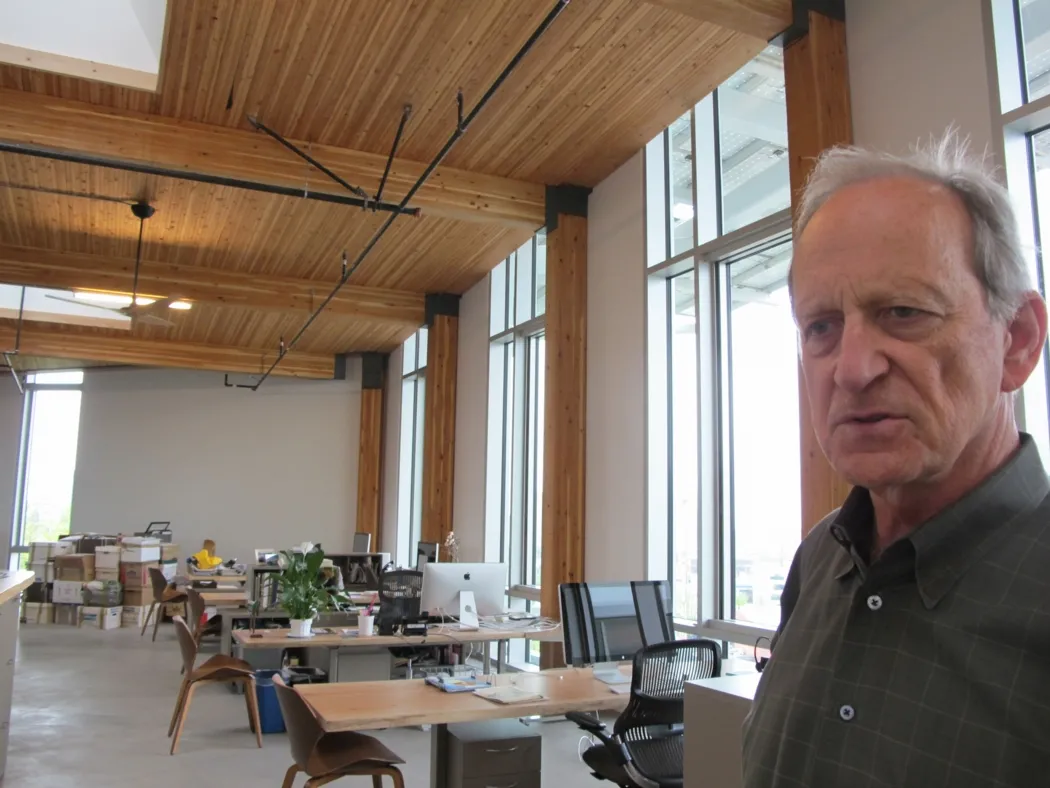
Denis Hayes, president of the Bullitt Foundation, explaining features of the building.
The Living Future Conference was created initially to provide a networking and learning venue for designers and builders involved in creating buildings that achieve the Living Building Challenge. Unlike its better known cousin, the LEED Rating System (Leadership in Energy and Environmental Design) of the U.S. Green Building Council, the Living Building Challenge (LBC) is not a points-based system, but rather a collection of very specific, very challenging requirements.
To achieve LBC certification, buildings must:
- operate on a net-zero-energy basis—using no more energy, on an annual basis, than is collected by the building (LBC certification can not be earned until a full year of data is collected proving that it is actually operating to be zero-net-energy);
- operate on a net-zero water basis—using no more water on an annual basis than is collected on the site;
- contain no “red list” chemicals—the LBC maintains a long list of chemicals that cannot be used, including polyvinyl chloride (PVC), brominated flame retardants, and heavy metals like the mercury found in fluorescent lights; and
- address various other requirements related to the building site, health, equity, and beauty (yes, beauty). Each of these categories (energy, water, materials, site, health, equity, and beauty) are referred to as petals in the program.
Needless to say, achieving LBC certification is very hard. Since the launch of the program seven years ago only a handful of buildings have achieved full certification (4 and counting), and another half-dozen have been recognized for achieving LBC requirements in individual petals. When it comes to larger, multi-story office buildings, the requirements for LBC have seemed almost out of the realm of possibility—at least until now.
The Bullitt Center
The Bullitt Center is a remarkable building that is well on its way to becoming the first sizable commercial office building to achieve LBC certification. The six-story, 52,000 square-foot commercial building, which is owned by (and houses) the Bullitt Foundation, had its grand opening on Earth Day this year (particularly appropriate, since the long-time president of the Bullitt Foundation, Denis Hayes, was the director of the first Earth Day in 1970).
The building was designed by the Miller Hull Partnership in Seattle, with other members of the integrated design team including Point32, PAE Consulting Engineers, Foushee, Luma Lighting Design, 2020 Engineering and Berger Partnership.
Among the building’s features:
Rainwater harvesting
The building has a 56,000-gallon cistern for storage of rainwater that is harvested on the roof. This water, after filtration and multi-stage treatment and polishing, can supply 100% of the building’s water needs, including drinking water, the three ounces of water used per flush in the foam-flush toilets, showers for bicycle commuters (there are showers on each floor), and landscape irrigation. (Permitting issues are still being worked out to allow the building to use only site-harvested water, but hopefully that will be resolved.) Interestingly, while Seattle is cloudy a lot of the time (225 cloudy days per year) and it rains a lot (150 days per year), Hayes told me that the total rainfall is modest: only 37 inches per year on average, compared with 43 for Boston and 49 for New York City. The exception to the self-contained water system is the building’s sprinkler system, which the city required be on municipal water pressure.
Composting toilets
To get the building’s water consumption low enough to satisfy it entirely with site-harvested water required composting toilets. The four foam-flush toilets on each floor (24 total) deliver waste to ten Phoenix composting units located in the basement. As far as I know, this is the only building over four stories to rely exclusively on composting toilets.
Durability
The building’s timber structure is designed for a 250-year life, and the building envelope (or skin) has a projected life of 50 years before it will need replacement—which can happen without affecting the structure.
Local materials
Reflecting the Pacific Northwest’s timber resource as well as a desire to minimize embodied energy of materials, all of the structural wood for the building is local Douglas fir from forests that were certified to Forest Stewardship Council (FSC) standards. Glulam beams are produced from two-by dimension lumber. Incidentally, the Bullet Center is the largest heavy-timber building constructed in Seattle since the 1920s.
Safe materials
Tremendous effort was expended to avoid the use of several hundred red-list chemicals. Manufacturers whose products were used have to go through the International Living Future Institute’s Declare program or produce a Health Product Declaration to certify that red-list chemicals are not used. This feature of the Living Building Challenge is having a huge influence on product manufacturing today, leading to greener products. A number of manufacturers altered their manufacturing to comply with LBC requirements, so other (non-LBC) projects using those materials will benefit.
Occupant comfort and daylighting
All tenants in the building will have access to daylight, either from adjacency to outside walls or through glass interior partition walls. Even the stairwell is fully daylit, a particular requirement of Hayes, who calls it the “irresistible stair” that will encourage occupants to walk rather than taking the elevator. Views of downtown Seattle from the stairwell make the walk worthwhile.
Cost
As might be expected, the Bullitt Center wasn’t an inexpensive building. At $18.5 million dollars, or $355 per square foot, this is about $50/sf above the average for high-quality, Class-A office buildings in the region, according to the Bullitt Foundation. But it is a demonstration of pushing the envelope and proving that the environmental impacts of buildings can indeed be dramatically reduced.
Office space in the building is being leased at $28–30 per square foot per year, slightly higher than average for Seattle, but tenants get free electricity and water at that price—as long as they keep within their allotted limits.
The Bullitt Center is indeed a milestone building—I believe one of the most important commercial buildings of the past 50 years.
Alex is founder of BuildingGreen, Inc. In 2012 he founded the Resilient Design Institute. To keep up with Alex’s latest articles and musings, you can sign up for his Twitter feed.