
7 Tips to Get More from Mini-Split Heat Pumps in Colder Climates
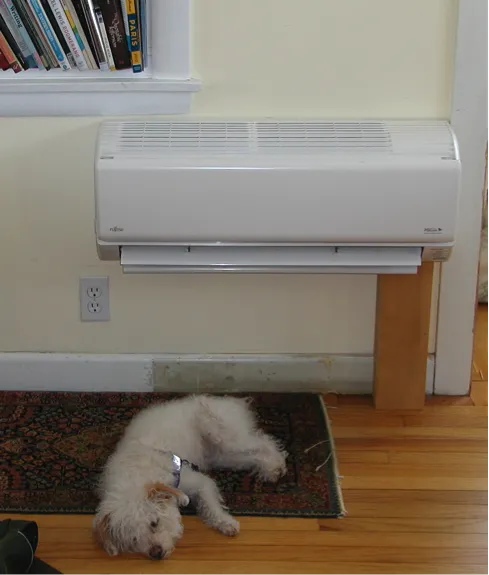
This is in its third season as the primary heater for our 1,500 ft2 home in Northfield, Massachusetts. The interior unit is 18" off the floor, and certain creatures like that very much.
[Editor's Note: This guest post comes to us courtesy of Peter Talmage, P.E., an energy and design consultant and an instructor in the Renewable Energy & Energy Efficiency program at Greenfield Community College. Originally published April 4, 2013.]
I have heated my various homes with wood since 1975. It was always a love/hate relationship. The wood fuel was “free” off my land, but burning it was a very dirty business in many ways.
Mini-splits in cold climates? Yes we can!
Three years ago, I installed a ¾-ton Fujitsu model air-source mini-split heat pump to heat my historic 1790 cape home here in Northfield, Massachusetts. It has been a great success.
During the winter of 2010–2011, the heater for my 1,500 ft2 home consumed 1,757 kWh from October 2010 to June 2011. For the warmer winter of 2011–2012, the usage was only 1,247 kWh from September 2011 to April 2012.
So far this winter, from October 2012, to March 23, 2013, the usage has been 1,501 kWh. I have a 5.4 kW PV array that supplies about 200% of my electrical consumption, including that of the heat pump, so the heating system is very “green.” I have since installed mini-splits in two other houses.
Below are my suggestions for successful house-heating with a mini-split—even in a cold, Northern New England climate like mine.
1. Reduce load first
Improve the thermal envelope of the structure to minimize the size you’ll need and to reduce overall energy use.
2. Size it right for typical low temperatures
Heat-pump output drops as the outdoor temperature drops. I recommend sizing the heat pump to meet heating load at, say, 10°F. During periods of lower temperatures, use simple electric resistance heating or another source to make up the difference.
Also, remember that a heat pump doesn’t have the capacity to quickly bring a cold house up to temperature. I set the temperature to 60°F whenever the house is unoccupied temporarily or at night and down to 50°F for extended periods of no occupancy. (At the 50° setting, the interior units typically keep air circulating constantly to prevent overly cold spots from developing.)
3. Prepare for a little noise
The interior unit makes noise—not a lot, but a varying level of whoosh. Make sure you can live with it before you install one. Find an installation and listen. If you like a dead-silent house, a mini-split isn’t for you.
4. Let it snow—but not on your outdoor unit!
The outdoor compressor unit needs to be mounted at least two feet above the ground here in snow country. It also needs to be well protected by a roof or cover that does not restrict airflow but doeskeep snow off and away from the unit.
In normal operation, the evaporator will freeze moisture from the air, which takes some extra energy. This ice is melted off during the defrost cycle. The melt-water drains out under the unit and sometimes forms a small glacier. The energy balance of this evaporator freeze/thaw cycle isn’t all that bad because the ice releases heat as it changes phase.
What can drastically reduce the performance of a heat pump, though, is when the evaporator gets plugged with snow. There is no gain of latent heat here, only energy consumption to melt the snow out. If the evaporator is located so snow can easily be sucked into it, the compressor will spend a great deal of its time melting snow and not heating the house.
My latest mini-split installation has the evaporator drawing air from an enclosed porch space. Air is pulled into the porch at low velocity through the spaces between the floorboards. Snow drops out of the air before it enters the porch, so it can’t plug up the evaporator. A second benefit is that the porch warms up in sunny weather, improving efficiency.
5. Get the low-down on indoor mounting
For heating, the interior unit should be mounted about 18 inches off the floor and should have a good, clear shot into the living space. Mounting the unit low has many benefits for heating:
- First, it operates more efficiently because it is pulling in cooler air to warm up.
- Second, the warmed air is blown out across the floor and mixes with the cold air at floor level.
- Third, the air isn’t blowing directly on occupants, which can cause discomfort in the winter unless the moving air is very warm.
- Fourth, it is very easy to access the filters for cleaning.
6. Right-size the pipes too
The interior and exterior units need at least 15 feet of piping to ensure no noise transfer from the compressor to the inside unit. Greater lengths of tubing are allowed, depending on the manufacturer, but will lower efficiency.
7. In warmer climes, get maximum efficiency
In colder climates, heat pumps need to strike a balance between efficiency (measured as heating seasonal performance factor, or HSPF) and lower operating temperatures. The warmer your climate overall, the more weight you should put on the efficiency side of the equation.
In central New England and south, go for units that have higher HSPF rating over lower operating temperatures. Most of the time, the compressor will be seeing temperatures of 20°F or higher. Rarely will it be running at –10°F. The latest Fujitsu 9RLS2 has an HSPF of 12.5 Btu/Wh.