As the third credit in the building product disclosure and optimization (BPDO) trio of credits, Material Ingredients rewards you for using products that have disclosed their contents (Option 1) and/or improved them (Option 2).
Each option is good for one point. You don’t have to achieve the Option 1 point to go after the second point, but Option 1 is low-hanging fruit and much easier to satisfy. Option 2, while more within reach under v4.1 following the Q2 addenda, is a bit harder, requiring an action plan or third-party-verified disclosure.
Option 1: Material ingredient reporting
To earn the point, use at least 20 products that have disclosed their contents using a format like the Health Product Declaration (HPD), or a labeling program such as Declare. HPDs and Declare labels are two of a host of approved disclosure formats, and manufacturers can even create their own inventories.
Finding compliant products has gotten quite easy, especially since they don’t have to come from 20 different manufacturers: only five companies have to be represented. If you have a primer and a topcoat from the same paint supplier, and both have a compliant transparency report, you’re already one-tenth of the way to your 20 products. Some projects are even finding 40 products to earn the exemplary performance point. We recommend starting with acoustic ceiling tiles, paints/coatings, flooring, and insulation.
Note that interior, warehouse, and core-and-shell projects only have to get ten products.
Finding products is simple
A handful of databases, including the Health Product Declaration Collaborative’s repository and the Declare website, make it easy to find products that meet these requirements. You can also search using the Better Materials meta-database.
Unless you manage to find all your products with pre-screening done by GBCI, you do have to know what to look for to avoid getting stung by a surprise rejection. Some documents sound like the right thing, but if they don’t meet LEED’s specific requirements, they don’t count. Here’s a quick run-down of each of the options, where to find them, and what you need to know about each:
Manufacturers’ self-reported inventory: not any list of ingredients will count; they have meet specific requirements. We’re not aware of an aggregated list of these, so you have to check each company’s website for them.
Health Product Declarations (HPDs): There are thousands of HPDs in the HPD Public Repository, but many of them don’t meet the requirements for a LEED-compliant HPD: these include disclosing down to a threshold of 0.1% (1,000 parts per million). HPD Collaborative has useful graphics that walk you through what to look for in confirming HPD compliance. The repository also has filters that let you select for pre-approved HPDs: just for Option 1 OR for both options. Fortunately, later versions of the HPD format include an automated check for LEED requirements, so there should be less confusion about this over time, as more HPDs are updated to the new format. In the meantime, some of the databases discussed in our guide include an option to filter for LEED compliance. It’s still a good idea to check each one you’re using against the criteria for LEED compliance.
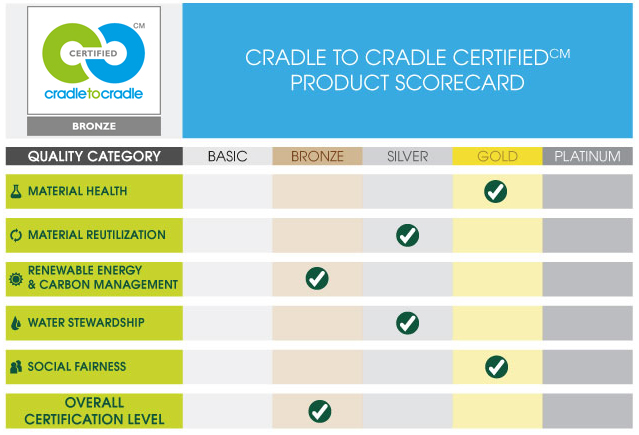 Cradle to Cradle (C2C) version 3 full certification or “Material Health” certification.
- In either case the product has to achieve Bronze level or better; for the Material Health option you also have to verify that at least 90% of the product’s contents have been assessed.
- It’s easy to search the C2C database for products based on certification level. You’ll have to check for the 90% threshold if you go the Material Health route.
Declare. According to the LEED credit language, the Declare label has to show that ingredients have been evaluated and disclosed down to 1,000 ppm. There are two problems with this.
- First, not all products with Declare labels meet this standard.
- Second, the label itself doesn’t say what threshold was used.
The goods news is that the Declare database has a filter to help you find those that do. Here’s how it works.
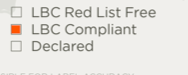
- There are three status options on a Declare label: LBC Red List Free, LBC Red List Approved, and Declared.
- A label with the status “LBC Red List Free” or “Declared” is good to go—those have to be screened to 100 ppm.
 If the status is “LBC Red List Approved,” you have to dig further because it’s possible for something to get this status under a special exception that doesn’t require full disclosure. The exception to watch out for is “I10-E4 Proprietary Ingredients <1%.”
- Even if it has this exception you might still be ok—you have to look at the ingredients list to see if the “proprietary ingredients” add up to more than 0.1% of the contents. If they’re under that threshold, the Declare label works for this credit.
- This all seems quite complicated: check out the graphic guide that explains all this in LEEDuser's Documentation Toolkit.
 ANSI/BIFMA e3 Furniture Sustainability Standard. Best known as BIFMA “Level” certification, this program addresses multi-attribute product sustainability—but you can be certified to the standard without meeting LEED transparency requirements. That’s why you have to specifically confirm that the product earned transparency points: at least 3 points under 7.5.1.3 Advanced Level in e3-2014.
Product Lens is a relatively new program from UL Environment, hardly any products are currently certified to it. You can check for them in UL’s SPOT database.
Facts – NSF/ANSI 336: Sustainability Assessment for Commercial Furnishings Fabric is a standard for certifying textiles for sustainability. Several different organizations certify products to this standard, so they’re listed in various places. Products can be certified at any level. SCS Global Services is the most active certifier under this standard.
USGBC approved program. If the past is any indication, USGBC will keep adding more programs to this list.
Option 2: Material Ingredient Optimization
Option 2 is finally within reach following the Q2 addenda release. Project teams must only find five permanently installed products from at least three different manufacturers that hold compliant third-party-verified material ingredient reports or action plans.
While it’s a bit trickier to find products with third-party-verified disclosure reports, meeting these stiff standards for hazardous ingredient avoidance can also help teams achieve Option 1: if you find five products compliant under Option 2, you’re 50% of the way to Option 1 achievement.
Under Option 2, products demonstrating optimization through an HPD, a Declare Red List Free label (either of these must be third-party verified), or Cradle to Cradle Material Health certification to the Bronze level are counted as one full product. Products count as 1.5 products if they are certified at the Silver level or higher for Material Health through Cradle to Cradle, by demonstrating exceptional optimization through an HPD, or through Living Product Challenge certification that includes achievement of the Transparent Material Health imperative. (Note that, in practice, choosing C2C products is probably the simplest way to hit Option 2.)
No third-party-verified report? Don’t fret—there is a pathway for half credit if manufacturers have a “screening and optimization action plan.” This action plan must be product-specific and must commit to specific dates for achieving material ingredient optimization.
Wondering where to start? Try searching material databases like HPDC’s repository, the Better Materials database or Sustainable Minds Transparency Catalog for paints/coatings, insulation, flooring, glazing assemblies and furniture. Interior finishes are a gold mine for material ingredient reporting.
Things are easier if you’re outside the U.S. because there is also an option based on the European REACH framework that identifies substances that are subject to special scrutiny. To count for LEED you just have to find products that are documented to be free of any REACH substances.
What’s New in LEED v4.1
- Getting to 20 products was doable for a typical whole building but daunting for a tenant fit-out or warehouse that used only a small selection of products. Those simpler project types now need only ten products from three manufacturers.
- The previously unachievable Option 2 is completely revised to make it much easier.T he thresholds that were out of reach have been cut drastically since v4.1 beta, from 10% of products by cost to just 5 products by count as of April 2021.
- There is no longer a 30% cap on number of contributing products coming from the structure and enclosure.
- Third-party-verified HPDs and Declare labels showing reduced hazards are given extra credit.
- Living Product Challenge has been added as an optimization pathway.
Should I upgrade?
The major changes to this credit align it better with where the market actually is. Hitting Option 1 was already achievable, but stretching to Option 2 is now potentially doable as well. This is a great option for upgrading.