Third of the three building product disclosure and optimization (BPDO) credits, Material Ingredients rewards you for using products that have disclosed their contents (Option 1) and/or improved them (Options 2 and 3).
Each option is good for one point, through the most you can earn for the credit is two points. You don’t have to achieve the Option 1 point to go after the second point, but you’d be crazy not to because Option 1 is quite easy, while the other is essentially out of reach.
Option 1: Material ingredient reporting
To earn the point, use at least 20 products that have disclosed their contents using a format like the Health Product Declaration (HPD), or a labeling program such as Declare. There are actually a whole bundle of approved ways for manufacturers to provide this transparency information, including making up their own form.
Finding compliant products has gotten quite easy, especially since they don’t have to come from 20 different manufacturers: only five companies have to be represented. So if you have a primer and a top coat from the same paint supplier, and both have a compliant transparency report, you’re already one-tenth of the way to your 20 products. Some projects are even finding 40 products to earn the exemplary performance point within reach.
Finding products is getting easier
A handful of databases make it easy to find products that meet these requirements. None of these is both comprehensive and user-friendly, but they’re getting better. See our guide to Product Libraries To Help You Achieve LEED v4 Material Credits for details.
You do have to know what to look for to avoid getting stung by a surprise rejection. Some documents sound like the right thing, but if they don’t meet LEED’s specific requirements they don’t count. Here’s a quick run-down of each of the options, where to find them, and what you need to know about each:
Manufacturers’ self-reported inventory: not any list of ingredients will count; they have meet specific requirements. We’re not aware of an aggregated list of these, so you have to check each company’s website for them.
Health Product Declarations (HPDs): There are now over 2,000 HPDs in the HPD Public Repository, but many of them don’t meet the requirements for a LEED-compliant HPD, which include disclosing down to a threshold of 0.1% (1000 parts per million). HPD Collaborative has useful graphics that show these requirements. Fortunately, the latest version of the HPD format includes an automated check for LEED requirements, so there should be less confusion about this over time, as more HPDs are updated to the new format. In the meantime, some of the databases discussed in our guide include an option to filter for LEED compliance. It’s still a good idea to check each one you’re using against the criteria for LEED compliance.
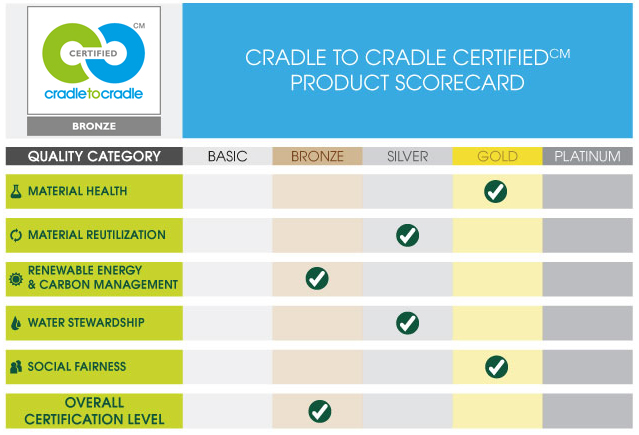 Cradle to Cradle (C2C) version 3 full certification or “Material Health” certification.
- In either case the product has to achieve Bronze level or better; for the Material Health option you also have to verify that at least 90% of the product’s contents have been assessed.
- It’s easy to search the C2C database for products based on certification level. You’ll have to check for the 90% threshold if you go the Material Health route.
Declare. According to the LEED credit language, the Declare label has to show that ingredients have been evaluated and disclosed down to 1,000 ppm. There are two problems with this.
- First, not all products with Declare labels meet this standard.
- Second, the label itself doesn’t say what threshold was used.
The goods news is that the Declare database has a “LEED v4” filter to help you find those that do. Here’s how it works.
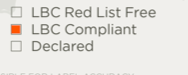
- There are three status options on a Declare label: LBC Red List Free, LBC Compliant, and Declared.
- A label with the status “LBC Red List Free” or “Declared” is good to go—those have to be screened to 100 ppm.
 If the status is “LBC Compliant” you have to dig further, because it’s possible for something to get this status under a special exception that doesn’t require full disclosure. The exception to watch out for is “I10-E4 Proprietary Ingredients <1%.”
- Even if it has this exception you might still be ok—you have to look at the ingredients list to see if the “proprietary ingredients” add up to more than 0.1% of the contents. If they’re under that threshold, the Declare label works for this credit.
- This all seems quite complicated: check out the graphic guide that explains all this in LEEDuser's Documentation Toolkit.
 ANSI/BIFMA e3 Furniture Sustainability Standard. Best known as BIFMA “level” certification, this program addresses multiattribute product sustainability but you can be certified to the standard without meeting LEED transparency requirements. That’s why you have to specifically confirm that the product earned transparency points: at least 3 points under 7.5.1.3 Advanced Level in e3-2014.
Product Lens is a relatively new program from UL Environment, hardly any products are currently certified to it. You can check for them in UL’s SPOT database.
Facts – NSF/ANSI 336: Sustainability Assessment for Commercial Furnishings Fabric is a standard. Several different organizations certify products to this standard, so they’re listed in various places. Products can be certified at any level. SCS Global Services is the most active certifier under this standard.
USGBC approved program. If the past is any indication, USGBC will keep adding more programs to this list.
Option 2: Material Ingredient Optimization
The two optimization options set a very high bar: 25% of the materials in a project (by cost) have to comply. For most projects in the U.S., at least, this point is not worth pursuing—at least not in 2017—but if you’re determined to give it a try here’s what you need to know.
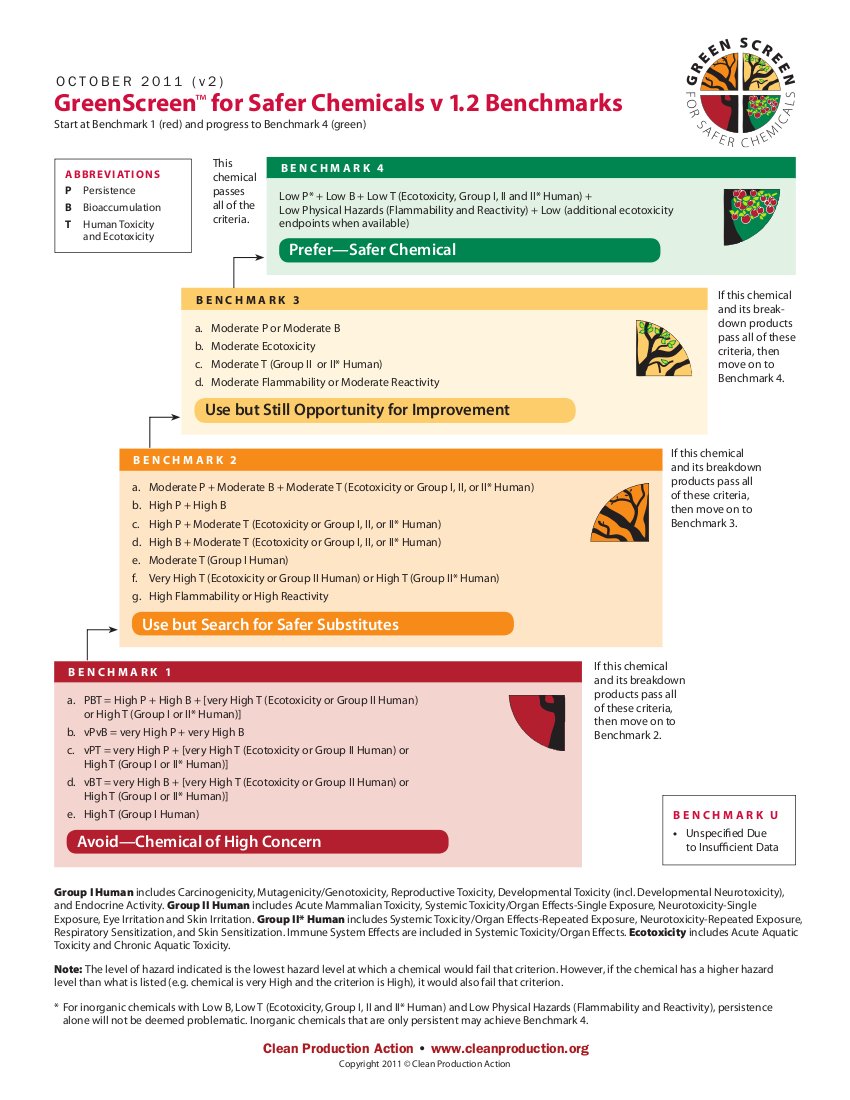
Under Option 2, products have to meet stiff standards for avoiding hazardous ingredients. They can be certified at the Silver level or higher through Cradle to Cradle or be free of any hazards as identified by the GreenScreen system. Only full Cradle to Cradle certification qualifies. C2C Material Health certifications don’t count here.
Things look better if you’re outside the U.S., because there is also an option based on the European REACH framework that identifies substances that are subject to special scrutiny. To count for LEED you just have to find products that are documented to be free of any REACH substances.
There is an option to get extra credit here. If a product is certified C2C Gold or Platinum you get 1.5 times its cost toward the 25% threshold. For example, if you spent $10,000 on C2C-Gold certified carpet, the calculation counts that as $15,000 worth of material. The same multiplier applies if all ingredients are determined to be hazard-free using a full GreenScreen assessment, as opposed to the more cursory (and much more ubiquitous) GreenScreen List Translator.
Option 3: Supply Chain Optimization
This option was introduced late in the LEED v4 development process with input from the chemical industry, which was aggressively resisting LEED’s push into product transparency.
Supply Chain Optimization rewards the use of products from companies that have robust environmental and health management systems. This incentive applies not only to the manufacturer that supplies the final product to the jobsite, but also to its suppliers, especially if the final product contains potentially hazardous substances.
When LEED v4 was launched Option 3 wasn’t available because the guidance on how to use it hadn’t been developed yet. That guidance now exists, and a handful of suppliers are starting to document their compliance with it so that their products can count. At this point, we’re aware of only one company that claims to be in compliance—Milliken Flooring, audited by GreenCircle. Filter the GreenCircle database by “GreenCircle Audited” to find the products.
The 30% cap on structure and shell is softening
As if it wasn’t hard enough to get to 25% of products meeting one of these options, there is another constraint. According to the credit language, only 30% of the materials contributing to that threshold can be part of the structure or enclosure.
This limitation is so onerous, especially for core and shell projects, that USGBC revised it in July 2017 to allow project teams to use include more than 30% if they document that their overall materials budget is more than 30% invested in the structure and enclosure.
Local products can help, but only if they’re really local
There is another clause in the Options 2 & 3 section that could make it more achievable, but don’t be fooled. You can get double credit for products that come from within a 100-mile radius. However, it’s not enough for them to be manufactured within that radius; the raw materials have to originate there as well.
Yes, you can take partial credit for a local product that includes some local raw materials. This option should be useful for materials like gravel, sand, and wood, if you have access to them locally. More complicated, manufactured products are out of the picture.
The high bar for option 2, the novelty of option 3, and the cap on contributions from structural and envelope products all add up to a optimization point for material ingredients that remains, at least for now, out of reach.
What’s New in the LEED v4.1 beta
- Getting to 20 products was doable for a typical whole building but daunting for a tenant fit-out or warehouse that used only a small selection of products. Those simpler project types now need only ten products from three manufacturers.
- The previously unachievable Option 2 is completely revised to make it much easier. The thresholds that were out of reach have been cut drastically, from 50% and 25% down to 10% of products by cost. You also now have the option of skipping the “by cost” calculation entirely and earning these points by using ten different products.
- There is no longer a requirement for no more than 30% of the products to be in the structure and enclosure.
- Third-party-verified HPDs and Declare labels showing reduced hazards are given extra credit.