
This credit uses intersection density as a proxy for the level of community connectivity, transit accessibility and walkability.
Intersection density corresponds closely to block size: the greater the intersection density, the smaller the blocks. Small blocks contribute to neighborhood walkability.
In recent years, a growing body of research has confirmed that intersection density is one of the most important factors for encouraging pedestrian travel. Intersection density is also associated with fewer vehicle miles traveled, reduced risk of fatalities and serious injuries from auto crashes, faster emergency response, and, in conjunction with complementary urban design, reduced incidence of burglary.
Available to LEED for Homes
PC8 is open via IDc1, Path 3 to all projects using these LEED rating systems: LEED for Homes, and Homes Mid-Rise.
Credit Submittals
General
- Register for Pilot Credit(s) here.
- Register a username at LEEDuser.com, and participate in online forum
- Submit the feedback survey using the link on the USGBC.org credit page; supply PDF of your survey/confirmation of completion with credit documentation
Credit-Specific
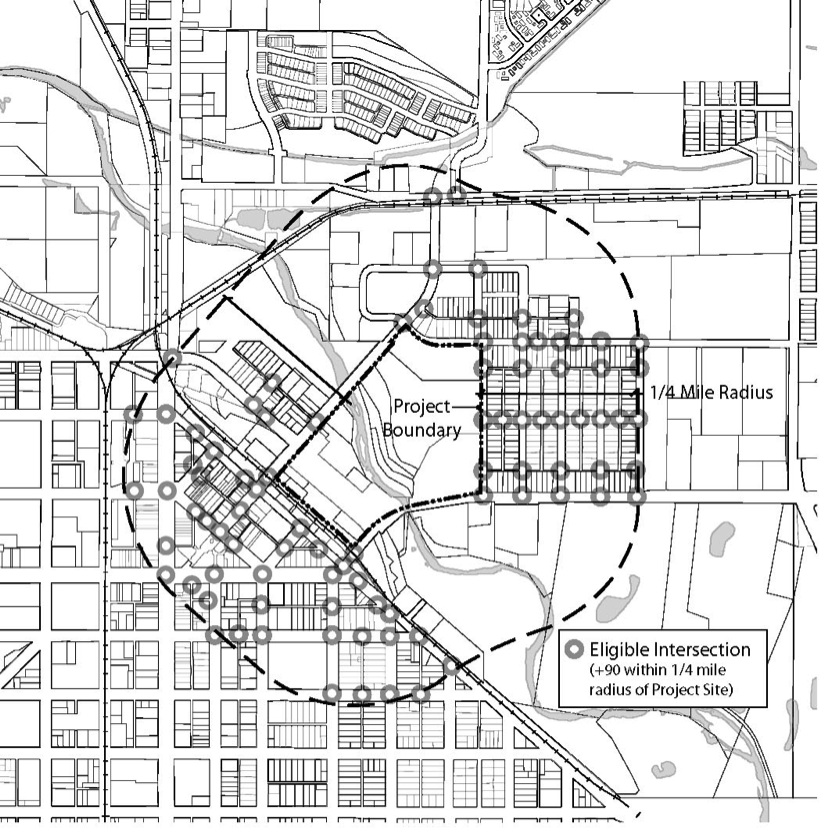
To gain credit, submit an aerial map of the project and surrounding area. Create a circle with a ¼ mile radius, and mark each intersection within that radius with the following caveats:
- All streets and sidewalks that are counted toward the connectivity requirement must be available for general public use and not gated. Gated areas are not considered available for public use, with the exception of education and health care campuses and military bases where gates are used for security pur-poses.
- Sidewalk intersections may be counted only if they are a unique and dedicated right of way
- Publicly accessible alleys may be counted.
- Intersections leading to cul-de-sacs are not counted.
Credit is earned for projects with at least 60 intersections within a ¼ mile radius
Additional Questions
- Did you find that the number of intersections near your project was an effective measure of project connectivity to the local community?
- If the number of intersections was low, can you identify a reason (rural setting, proximity to a large open space etc.)
- Do you think the requirement thresholds should be increased or decreased? Why?
- Would you consider your project site to be well connected (i.e., meets the intent of this credit)? Is this reflected in your intersection count?