Purpose of Demand Response (DR)
Demand Response is defined as changes in electric use by demand-side resources from their normal consumption patterns in response to changes in the price of electricity or to incentive payments. These are designed to induce consumers to change electricity use in response to high wholesale market prices or when system reliability is jeopardized.
When weather temperatures rise or fall dramatically, and use of air conditioning or heating is increased, the electricity grid must adapt quickly. Commercial and industrial buildings with a peak demand load greater than 200 kilowatts (kW) have a significant impact on energy demand and electricity grid stability in general, and through participation in Demand Response. This is especially true in urban and business areas with large clusters of commercial buildings or industrial operations.
When the electric grid is near its capacity or electricity prices are high, building operators can participate in reliability-based or price-based Demand Response programs that provide incentives for reducing the building’s energy demand during peak hours. Reductions in energy demand during peak hours may be facilitated by shifting electricity use to another time period or by taking measures to reduce electricity demand in the building.
Buildings that participate in DR programs offered by utilities, Independent System Operators (ISO), Regional Transmission Organizations (RTO) and Curtailment Service Providers (CSPs) can secure electricity supply, earn revenues and impact their electricity rates. For example, commercial and industrial buildings utilize load control technologies to change their consumption patterns and benefit by lowering building electricity costs. Programs types vary, and include:
- Economic, or price-based, programs such as Critical Peak Pricing (CPP), Time of Use (TOU), Price Responsive Load Programs
- Capacity Programs, which help utilities manage daily wholesale price fluctuations and economic costs
- Emergency programs which preserve reliability and prevent outages by signaling customers to reduce usage when demand exceeds the physical capacity of the grid
Value of Automated Demand Response
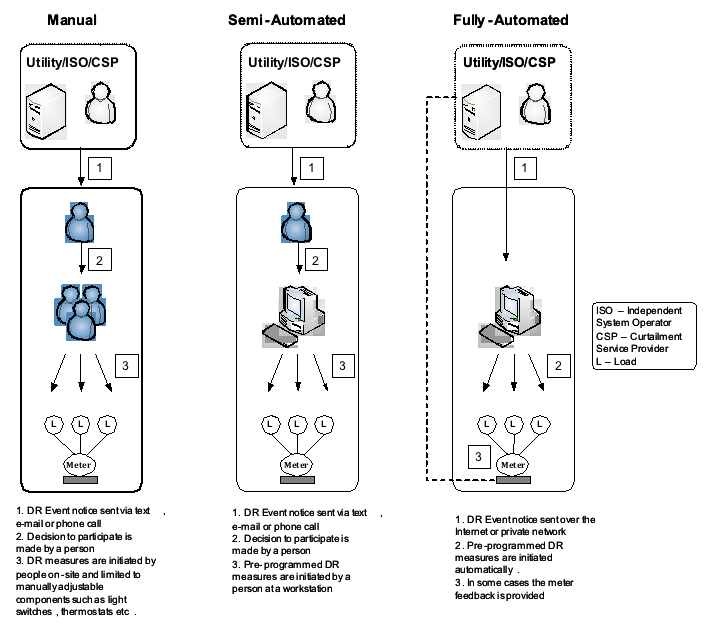
Buildings can participate in Demand Response through both manual and automated strategies. Manual strategies, which involve extensive human intervention to complete, are used when the reduction of Peak Demand is the primary objective. As buildings expand their use of Demand Response, they often look for ways to ‘shift’ demand to other time periods or modes systematically. As a result, they will invest in an Energy Management Control System (EMCS), such as a building automation system (BAS), and business processes, which support automated Demand Response. Demand shift strategies often lead to adoption of new energy management procedures, which reduce on-going energy usage, and in effect, reset peak demand.
Demand Response Automation Based on How Signals Transmitted
When a DR event is called, the DR program provider sends the signal in the manner specified in the Demand Response Enrollment Contract. The level of Demand Response automation is characterized by the way in which Demand Response signals are received and acted upon, through the Energy Management Control System, which can include one or more of the following: a Building Automation System (BAS), Building Management System (BMS), and Programmable Load Control (PLC).
Virtual Generation
Demand reductions, sometimes called “virtual generation”, benefit grid operators by increasing grid capacity, thus reducing the need for new generation, decreasing carbon and other emissions, and balancing supply and demand into a more efficient grid system. For maximum benefit, fully automated DR capabilities are required, in order to support the response timeframes required to participate in virtual generation programs.
For a list of Demand Response programs available across the country, please visit The Demand Response National Database.
Credit Submittals
General
- Register for Pilot Credit(s) here.
- Register a username at LEEDuser.com, and participate in online forum
- Submit the feedback survey using the link on the USGBC.org credit page; supply PDF of your survey/confirmation of completion with credit documentation
Credit-Specific
1. Demand Response – Participation Amount Contractual Commitment (DR-PACC)
(Not Applicable to Option 1, Case 2)
Submit proof of enrollment in a DR-Participation Amount Contractual Commitment, containing the physical address of the building(s), authorized agents for event notification, utility account numbers associated with each building, terms for earning revenue, terms for revenue sharing, number and duration of events, notification process, monitoring requirements, enrollment periods, minimum size, performance and consequences for non-performance, penalties and renewal options.
The official evidence of enrollment is the document or other verification issued by the ISO, RTO, or energy provider after the asset is successfully registered in a specific Demand Response program.
2. Demand Response Action Plan
Submit a comprehensive Action Plan, including:
- Potential for Demand Response Participation, such as curtailment of peak demand, and the elected Demand Response value, or schedule of values, in kWs, to be registered with the DR provider.
- Event notification process for Demand Response events, such as a phone call, an alarm with countdown clock or a signal to a BAS console, depending on the degree of Demand Response program automation, i.e. manual, semi-automated, or automated.
- Detailed procedures and responses to execute the Demand Response program measures consistent with the Demand Response Enrollment Contract and the registered Demand Response Participation Amount, including the notification method, specific actions, the order of execution, the load monitoring process and the post event recovery process.
- Energy Management Team responsible for management of the Demand Response program, and coordination with the Demand Response Program provider, the Facilities Department, and internal Risk Management, including Demand Response event notification and response, revenue settlements, contract administration, assessments, Demand Response action fulfillment, employee awareness training, Demand Response readiness drills, and energy management reporting.
- Description of end use systems which will be impacted, such as HVAC, or lighting, on a stand-alone, or integrated basis, during participation in Demand Response events.
3. Demand Response Test Report
(EBOM Only)
Submit evidence of Demand Response test conducted in compliance with the DR Program Provider’s test requirements to verify the building’s ability to participate in a DR event. The tests can be performed by the building’s facility engineer, a 3rd-party engineer, or other qualified parties, such as an energy services company (ESCO), in conformance with the Program Agreement.
4. Demand Response Training Program
Submit a training plan and objectives developed for those employees directly responsible for executing the Demand Response action plan that addresses key activities in implementation of the DR Action Plan, including:
- Individual assignments
- Event signals
- Communications protocols
- Recovery
- Reporting
- Clear status
For impacted employees and building occupants, provide training on possible impacts of various Demand Response events, such as shutdown of production lines, or changes in lighting or heating levels, and how to react and proceed during an event. Measures for personal safety, and proper evacuation, if needed, also should be addressed.
5. Demand Response Program Financial Analysis
Provide an evaluation of the financial investments required to implement and manage the Demand Response program. Where possible, calculate ROI or Payback, especially in those cases where significant infrastructure or personnel investments are made. Carefully evaluate the investments in personnel and capital equipment required. Key factors include:
- Capital Investment for new equipment or system modifications
- Changes to programming in existing BAS
- Rebates, Incentives, and Tariffs
- Projected revenues
- Energy Efficiency impacts and interactions with Demand Response.
Additional Questions
- Was demand response an effective strategy for your project?
- As a result of applying this strategy, did the project team use fewer energy efficient measures in the project?
- Were there barriers to implementing the strategies used under this credit?