
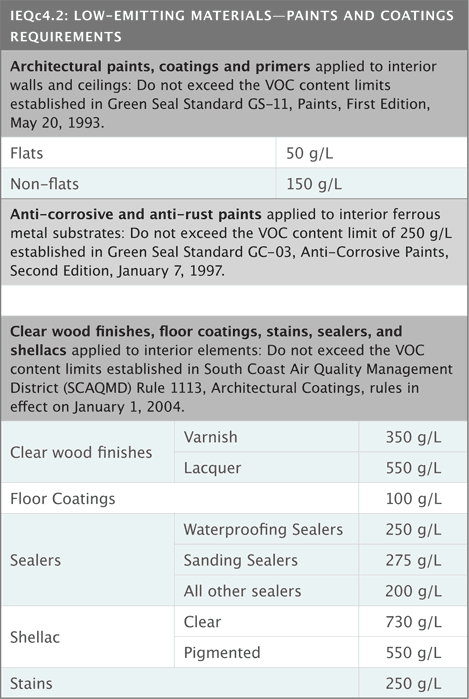
 Like the similar credit, EQc4.1: Low-Emitting Materials: Adhesives and Sealants, it shouldn’t cost you anything extra to earn this credit—it will just take some work. Your first priority should be to specify only paints and coatings that comply with the credit’s VOC limits, and enforce those specifications on the jobsite. Research low-VOC paints and coatings before construction begins and provide lists of acceptable materials to contractors to help ensure that the right products are used.
Performance should not be an issue
Major manufacturers offer paints and coatings that are just as durable and perform just as well as their higher-VOC counterparts. Performance of low-VOC products has sometimes been an issue in the past, but the market has largely moved beyond this point. Low-VOC acrylic paint is readily available. While it may be more difficult, it is not impossible to find low-VOC oil-based and high-gloss paints. Darker shades of paints also tend to have higher VOC levels. Rust proofing coatings also tend to have higher VOC content, but several name brand providers have low-VOC alternatives.
Proactive communication on the jobsite
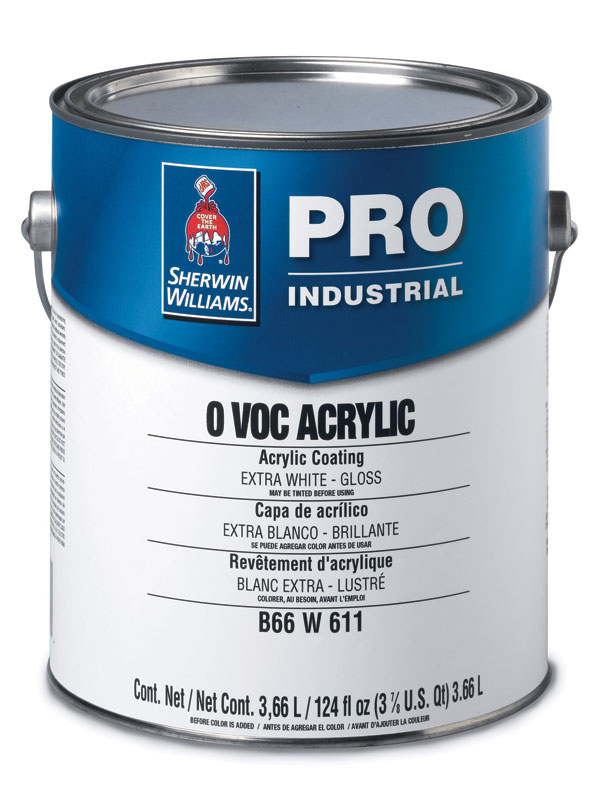
Low-VOC paint like this 0-VOC Acrylic from Sherwin-Williams does not have to sacrifice performance or cost. Photo – Sherwin-Williams Making sure that VOC limits are observed demands proactive communication between the designer, contractor, and all subcontractors who do work inside the building. Subcontractors have to be educated about the requirements, and their contracts should require that they document their compliance.
If you make a mistake, you can still earn the credit
Unlike some LEED credits where only a certain percentage of the materials have to comply, this credit is all-or-nothing—all paints and coatings must comply. If a non-compliant paint or coating gets used by mistake, or if you need to bend the VOC limits to meet the requirements of a warranty or fire code, you can still earn the credit following the “VOC budget process.” You’ll simply have to do some calculations to show that your extra use of VOCs was offset by very low use of VOCs elsewhere. You have to meet the budget for paints and coatings separately from adhesives and sealants (for EQc4.1), though—you’re not allowed to create a combined VOC budget covering multiple EQc4 credits.
Multiple benefits
Earning this credit is a key part of a construction indoor-air-quality management plan, and will help you earn another LEED point via EQc3.1: Construction Indoor Air Quality Management Plan—During Construction. Earning this credit can also help teams pass air quality tests needed to earn EQc3.2: Construction Indoor Air Quality Management Plan—Before Occupancy. Using low-VOC paints and coatings is not only beneficial to occupants, but can improve air quality and the health of construction workers who are constantly exposed to construction pollution.
Verify Your Information
Don’t allow the use of products that merely claim to be “low VOC.” Everyone specifying and purchasing products must actually find the products’ VOC content in grams per liter (g/L), which is usually found on the product’s technical data sheet or material safety data sheet, and compare that number with VOC limits listed for different uses determined by the South Coast Air Quality Management District (SCAQMD) Rule #1113 and Green Seal GS-11 and GS-03. Product cut sheets will not need to be uploaded to LEED Online to document compliance with this credit however, it is best to keep all product cut sheets on file in case the credit is audited.