
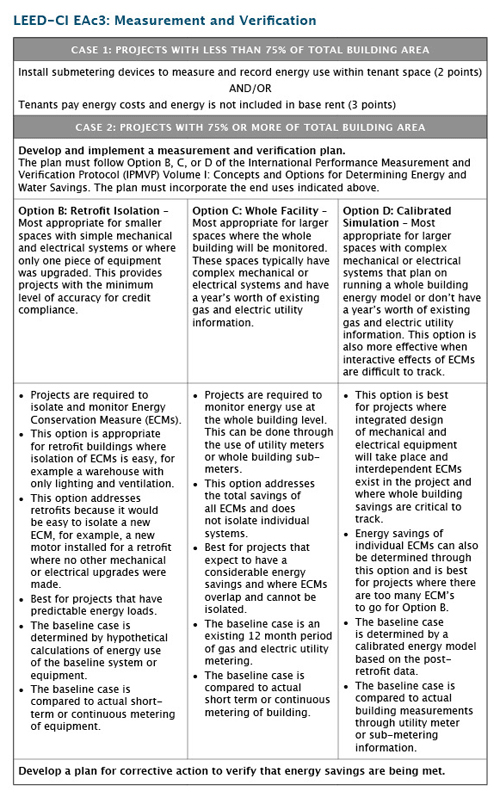
 An M&V program in a LEED-CI project will follow the following approaches depending on the percentage of the building your space occupies:
- Case 1: Projects that occupy less than 75% of the total building area. Your project does not need to develop an M&V plan, but you’ll need to submeter your individual space (separately from the rest of the building) and/or negotiate a lease that allows you to pay for the energy you use rather than a set amount included in your base rent. This allows you to benefit from any energy-saving upgrades you make as well as to be accountable for your own energy usage. Locating your tenant space in a LEED-CS certified building that has attained EAc5.2 will make achievement of the first option in Case 1 easier.
- Case 2: Projects that occupy 75% or more of the total building area. Your project needs to develop an M&V program, install continuous metering devices, and develop a plan for corrective action. An M&V program typically records actual energy and water use over the course of project occupancy and compares that data with design-estimated energy and water use. An M&V process ensures that your systems are performing as specified and identifies any anomalies in equipment, operational procedures, or user habits. An M&V plan can also help reduce energy and water costs, assist with commissioning and, over time, document and improve the efficiencies of conservation measures. While M&V for LEED-NC, CS, and Schools does not require monitoring water, M&V for LEED-CI projects does (only for Case 2 projects)—and you’ll need to install continuous metering equipment for the specific end-uses defined in LEED-CI requirements. Locating your tenant space in a LEED-CS-certified building that has attained EAc5.2 will make achievement of this credit easier. This option is virtually identical to the M&V credit for LEED-NC.
Why do M&V?
Despite aiming high during design, LEED-certified buildings don’t always perform as well as expected. A measurement and verification (M&V), or submetering, program not only can make building operators, owners, and tenants aware of performance issues and provide accountability for actual energy usage, but also locate the source of problems and identify poor design assumptions while providing a better overall sense of how the building’s systems are functioning.
Is it worth it?
The cost of an M&V program varies from one project to the next. Added costs come from designing and installing specific monitoring systems for larger and more complex buildings.
- Case 1: Projects that occupy less than 75% of the total building area. This is a pretty straightforward option that allows you to take advantage of any efficiency upgrades you install. For tenants occupying an entire floor, or multiple floors, submetering is usually simple, and can be accomplished with a utility grade check meter, or a direct utility meter (with separate billing). For smaller tenants that may share a floor, electrical distribution may also be shared. In this situation, installing metering may be more difficult, as multiple meters and/or reconfiguration of the electrical distribution may be required.
- Case 2: Projects that occupy 75% or more of the total building area. To make the investment worth it, the owner must be committed to developing and implementing an M&V plan, analyzing and understanding equipment performance, and acting on the results. The cost premium of M&V installation and operation is typically offset by long-term energy savings, but this is highly dependent on the building type as well as the owner’s and tenant’s willingness to make needed changes and implement upgrades.
Who does it?
The “M&V provider” takes responsibility for developing the M&V plan in spaces that occupy 75% or more of the total building area. This role can be filled by the commissioning agent, energy modeler, mechanical engineer, project engineer, or a facilities manager. In spaces that are less than 75% of the total building area, the owner typically works with the tenant to confirm accurate lease language, and the engineer provides the submetering devices and controls.
What’s the standard?
The industry standard for M&V, both in the U.S. and internationally, is the International Performance Measurement and Verification Protocol (IPMVP), owned by the nonprofit Efficiency Valuation Organization. LEED has singled out Volume I of the IPMVP guidance as the basis of its requirements. Several organizations have published M&V guidelines based on IPMVP. Among them are ASHRAE, the U.S. Department of Energy’s Federal Energy Management Program (FEMP), and some utilities and states that fund energy-efficiency projects. Some organizations with M&V standards offer guidance in writing M&V plans, including sample language.