
This credit requires surveying building occupants to find out if they are satisfied with thermal conditions in the building, as defined by the thermal comfort variables defined in ASHRAE 55-2004. The credit costs little or nothing to implement (although it does take some time), and provides important feedback to building owners and operators.
Do it yourself, or get help
If you have the internal staff resources and don’t want to pay for an outside service, you can go with a simple self-administered online survey.
If you want some hand-holding, can afford the (relatively low) fee, and are interested in a more comprehensive occupant survey (beyond just thermal performance) that gives you results in the context of a large dataset, use the service from UC Berkeley’s Center for the Built Environment or something similar.
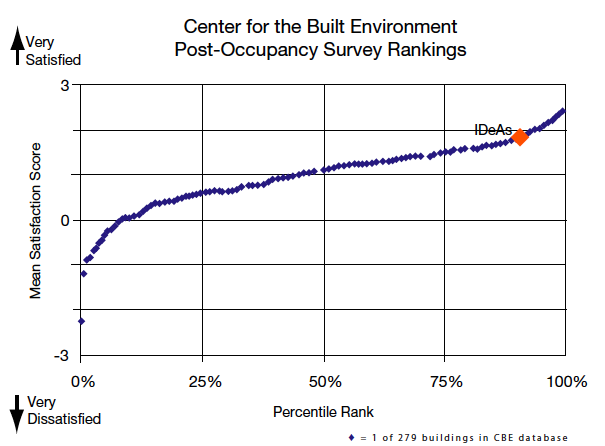 Some owners may have reservations about surveying occupants because they’re worried about getting poor results. Doing the survey through a third-party service that specializes in post-occupancy evaluations can help with that fear by returning individual building results in the context of results from many other buildings. If the survey turns up some weak areas, you’re likely to be in good company!
Permanent monitoring system
This credit also requires installation of a permanent monitoring system for NC and CI projects. The LEED Reference Guide provides no specific detail on the requirements for permanent monitoring systems, system components, or what to monitor. However, LEED-EBOM 2009 credit IEQc2.3 defines requirements for permanent monitoring that are a useful guideline:
- Continuous monitoring of, at a minimum, air temperature and humidity in occupied spaces. The sampling interval cannot exceed 15 minutes.
- Periodic testing of air speed and radiant temperature in occupied spaces. Using handheld meters is permitted.
- Alarms for conditions that require system adjustment or repair. Submit a list of the sensors, zone set-points and limit values that would trigger an alarm.
- Procedures that deliver prompt adjustments or repairs in response to problems identified.
Through communication with GBCI, LEEDuser has been told that "For the purposes of this credit in the LEED BD&C rating systems, a permanent monitoring system is defined as having regular, repeated comfort surveys distributed to the building occupants."
Corrective action
Develop a plan for corrective action in case more than 20% of respondents report dissatisfaction with thermal comfort. It is up to the owner and operations staff to determine how to implement the plan. For example, if occupants indicate that they are uncomfortable, the HVAC system is inspected and tested and there are no faults found with the HVAC system, technically you’ve done what’s required. (Although, it is a good practice to make operating adjustments until your occupants are reasonably comfortable!)
In general, implementing the plan is something that usually happens after the project is already LEED-certified. You have to do something to honor your commitment, but how far you go is up to you.
Submit the documentation early if you can
You don’t gain anything by waiting to submit for this credit until the construction submittal, but if you want to wait and see whether you’ll need the point before committing to it, you can. (Whether or not you pursue the credit, surveying occupants about their satisfaction is a good practice.)
The owner is the required signatory for this credit and has to verify that that the survey will be performed, along with a plan for corrective action.
Implementation of the occupant survey is the most difficult part of this credit. The occupant survey is to be implemented after six months of occupancy at the earliest. This credit is largely based on the honor system. There is no enforcement mechanism in place to confirm that the credit will be implemented after 6 months of occupancy or that the plan of corrective action be administered if 20% of survey respondents are dissatisfied with system performance, but the owner’s organizational integrity is at stake if they fail to live up to their commitments.