
This credit is focused on limiting environmental impacts from automobile use. It targets commuting specifically, but also addresses company vehicle fleets, maintenance vehicles, and buses.
If your project has substantial parking area, you may find the requirements of this credit to be low-hanging fruit, because you should easily be able to designate preferred parking for low-emitting and fuel-efficient vehicles, which is one option. There are other options for compliance, all of varying difficulty and requiring varying levels of commitment from the project owner.
Pick a path and go with it
It’s wise to choose your compliance path early in the process, especially since some of the options require infrastructure development such as alternative fueling stations.
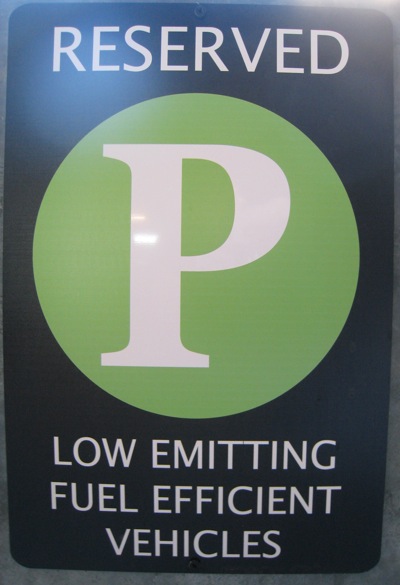 Make sure that you base your choice on the likelihood that building occupants will take advantage of the resources you provide. While this is not often done, surveying occupants or prospective occupants is a good way to determine which strategy is likely to have the highest impact.
A range of options
Option 1: Providing preferred parking for low-emitting and fuel-efficient vehicles is by far the most cost-effective option for projects that have onsite parking managed by the building ownership. “Preferred” is defined as easy to access (such as close to building entrances), or available at a discounted price.
Option 2: Providing onsite alternative fueling stations for 3% of total vehicle parking capacity is a bit more involved and potentially more expensive. The most readily accessible strategy here is providing plug outlets for electric cars.
Option 3: Providing low-emitting or fuel-efficient vehicles for 3% of FTE occupants along with preferred parking for these vehicles may be the most expensive approach to this credit. If a project already maintains a fleet of vehicles, however, then low-emitting and fuel-efficient vehicles can be substituted at no added cost—possibly even at a cost savings.
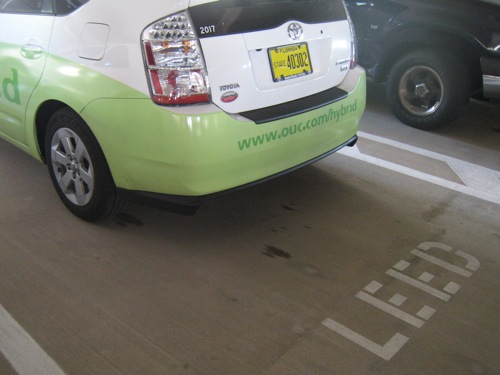 Option 4: Implementing a vehicle-sharing program with provision for designated parking for shared vehicles may be best integrated into residential or campus project programming.
Parking is not a prerequisite
Projects that do not provide onsite parking can still earn this credit by pursuing Option 4 and implementing a low-emitting and fuel-efficient vehicle-sharing program (many residential projects prefer this option). Projects may also earn the credit by pursuing Option 2, providing alternative fueling stations onsite.
Signage matters
Parking signage for this credit must typically include the terms "Low-Emitting" and/or 'Fuel-Efficient," with the only exceptions being "Zero Emissions Vehicles" or "ACEEE 40+." Signage using solely terms like "Alternative Fuel Vehicles," "Hybrid Vehicles," or "Electric Vehicles" is not sufficient, because some hybrid vehicles, etc., do not meet the LE/FE definition, and vice versa.