
This credit focuses on diverting waste from landfills by finding multiple alternatives for end uses of the waste, namely recycling, reuse on site, donation for reuse on another site, or resale. All of these diversion methods count towards credit compliance—50% construction waste diverted for one point, 75% for two points.
Look for opportunities to prevent the generation of waste on construction sites because the less waste you generate, the less you have to recycle or reuse to earn the credit.
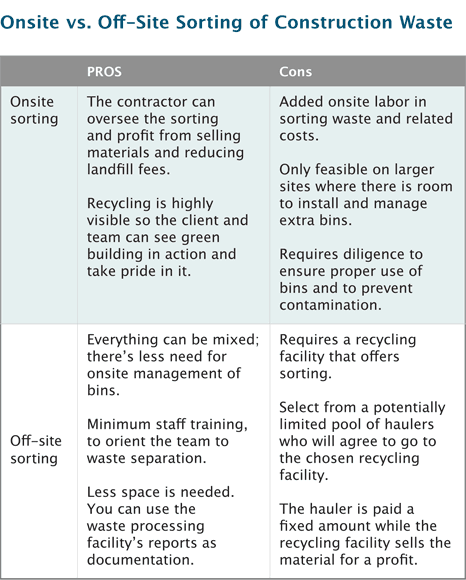
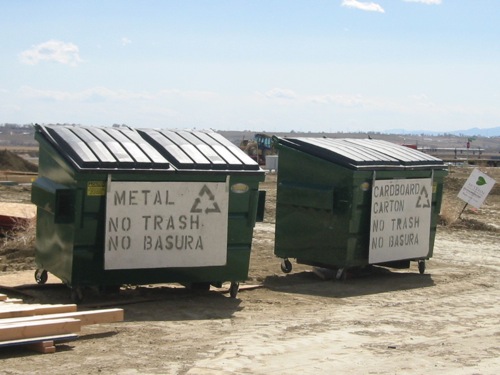
There are two different approaches to recycling construction and demolition (C&D) waste: separating materials at the source (onsite), or commingling them and sending them to an off-site waste sorting facility. Either approach can work well. Your choice will depend on whether there is room for sorting onsite, whether the contractor is willing to take that on, and if there are good sorting facilities nearby.
Factors that affect your likelihood of success
The ease or difficulty of this credit depends on project-specific and regional conditions.
- Local infrastructure: Construction waste management (CWM) is becoming standard practice in many parts of the country; however, in rural or remote areas, it may be more difficult to find recyclers and salvage yards. Whether or not the economics work in your favor depends on the tipping fees for disposing of waste at a landfill: high fees mean high avoided costs for recycling so you come out ahead.
- Is demolition involved? If so, this can be a relatively easy credit to earn. By donating, reusing, or recycling most of the demolition waste, you’ll have taken care of a significant portion of the project waste. Also, consider that re-use of existing buildings can save resources and cut down on waste when choosing a site for the project. However, this depends on the building type and the materials that will be demolished. For example, a site that previously had a concrete parking lot and no building will provide for a lot of heavy recyclable material. But, a site that had an old wood structure may be more difficult to divert.
- Have your contractors and waste haulers done it before? Their experience and commitment to making it work can make all the difference. It is crucial to educate contractors and subcontractors and to enable constant communication with field personnel in order to achieve these credit goals. Some contractors are regularly hitting a 90% target (versus a LEED target of 50% or 75%) whereas others can barely get to the 50% target.
 The general contractor (GC) is responsible for developing the CWM plan early in the construction process, if not before (during preconstruction). The GC does this in collaboration with the project team and is then responsible for implementing it, verifying that it is being followed throughout the construction process, and documenting the results.