
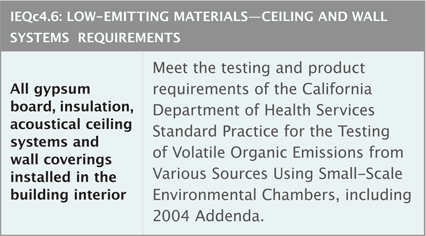
 This credit requires all of your ceiling and wall systems to comply with a high standard for low indoor emissions, which can be difficult.
Insulation, drywall, acoustic ceiling tiles and wall coverings all have to be included. If you cannot find an insulation that meets your needs and passes the testing requirements for low emissions, you cannot earn this credit, even if your drywall and ceiling tiles comply.
If your project is not in California where these requirements are more established, and you experience difficulty finding compliant products locally, you might have to make a trade-off and give up on this credit in favor of others. For example, a project team in Denver might have to decide between locally sourced and manufactured gypsum board and low-emitting gypsum board shipped from out of state.
This is a low-cost credit. Products that meet these standards most likely involve a small premium, but this is expected to decrease as this standard, and LEED for Schools, are more widely used.
Do the right things (at the right time)
Allow adequate time for product research. Researching compliant products before construction begins—and providing a list of acceptable materials—helps ensure that the right products are used. Products that meet California’s Section 01350 criteria also meet the requirements for this LEED credit. Occasionally, you may find a product data sheet that does not mention “Testing of Volatile Organic Emissions from Various Sources Using Small-Scale Environmental Chambers”—but if the cut sheet states that the product meets CA Section 01350 criteria, then it is compliant.
Project teams that successfully earn this credit typically include compliant products in their project specifications and educate contractors about the credit requirements. Documentation of and compliance with the credit requirements should be made a contractual obligation in contract language for contractors and subcontractors. The general contractor needs to understand the standards and credit requirements in order to know how to verify that products are compliant. This information can usually be found on the product data sheet.
Complying with this credit helps project teams that intend to perform air testing for IEQc3.2: Construction Indoor Air Quality Management Plan—Before Occupancy.