
All multi-occupant spaces (like classrooms or auditoriums) must have at least one occupant comfort control. Multifamily housing must also have one control per unit.
For individual spaces or open-plan offices, at least 50% of occupants must be able to control their individual comfort conditions.
A lot of options
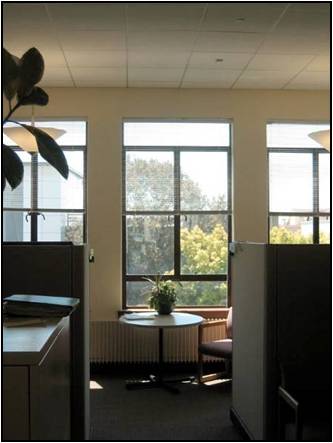 The credit defines comfort according to the four primary comfort criteria identified by ASHRAE 55-2004:
- air temperature
- radiant temperature
- humidity
- air speed.
A comfort control meeting the credit requirements needs to only address one of these four. Common ways to meet the credit include installing:
- heating radiators or radiant panels with individual temperature controls;
- operable windows;
- or adjustable local air diffusers.
Are desk fans allowed?
Is a desk fan an acceptable strategy? Some project teams have reported success with desk fans, but it may depend on your rating system.
LEED Interpretation #1722, 3/22/2007 which applies to NC-v2.2, but not officially to LEED 2009, states that they are not allowed, since the intent of the credit "deals with providing thermal comfort control as an integral part of the building design."
However, Reference Guide Addendum ID# 100000766, 2/2/2011, explicitly applies to LEED-2009 rating systems, and states that "Individual comfort plug-in devices are acceptable for meeting the intent of this credit" as long as they are included in your EAp2 energy model.
Choosing your ventilation system
You can meet this credit with either naturally or mechanically ventilated buildings.
Projects using natural ventilation need to provide access to operable windows for at least 50% of occupants. Access to an operable window means that an occupant's desk is located within 20 feet of a window to the inside, and ten feet from side to side.
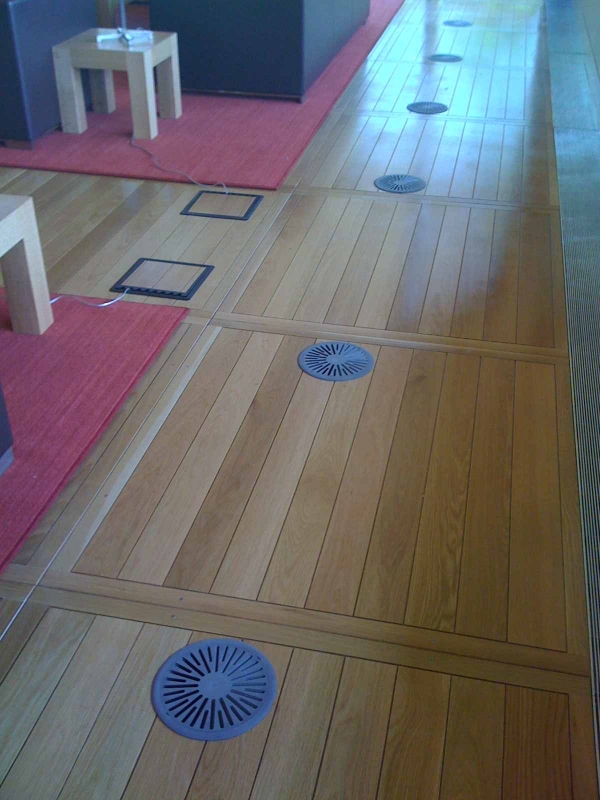
 It is more difficult to achieve credit compliance with mechanical systems like forced air because the controls typically serve a large area. You can provide a greater level of thermal comfort with underfloor air distribution that provide easily controlled diffusers.
For constant-air-volume systems that do not allow individual control, you may need to add an additional unit, such as a reheating coil at the diffuser or perimeter baseboard heating, to achieve the credit’s intent.
Heating or cooling
For mechanically ventilated spaces, previous LEED-certified projects have complied with the credit by providing occupant controls for heating or cooling only. For example, a building providing controls that adjust heat within a certain temperature range can comply with the credit, even if controls are not provided for the cooling season.
Approaching the credit by building type
Multifamily: For a small unit, you may only need a single control—it can be a window or a thermostat. Most units will require a control in each bedroom and in the living room or other multi-occupant spaces.
Offices: Private offices and open space offices need multiple controls for 50% of occupants. One control in each conference or meeting room.