
This credit rewards projects with up to six points for using renewable energy either through the purchase of green power (RECs and carbon offsets), the use of onsite renewable systems, or a combination of the two.
The decision to approach this credit through onsite or off-site renewable energy generally comes down to the following:
- The first costs of onsite renewable installation.
- Whether the owner supports the longer-term payback likely for onsite renewables.
- The compatibility of the building and systems with onsite renewables.
- The cost of offsite renewables and whether the owner perceives value in that.
- The kind of green story the building owner would like to tell.
Onsite is tough
Onsite renewable energy is rarely pursued by EBOM projects because it is can be expensive and technically challenging.
The credit allows for numerous different systems, including solar photovoltaic (PV) and solar thermal (hot water), to geothermal (harvesting heat from deep within the earth—not surface-level “geo-exchange”), wind, low-impact hydroelectric, and certain types of biomass. Of these, solar and solar thermal are the most widely used because they work with the widest variety of sites and microclimates.

What are RECs?
The market for renewable energy credits (RECs) and carbon offsets has exploded in recent years, but both are fairly abstract commodities that can be difficult to define.
For buildings that can’t generate onsite renewable power but want to use renewable energy, RECs (sometimes called “green tags”) allow customers to continue to buy the same grid-supplied power, while also buying the environmental attributes of electricity produced by a renewable source. (The actual renewably generated electricity is sold separately to the grid for market price as normal power.) To ensure quality, LEED requires you to purchase RECs certified by Green-e, a third-party program.
Costs for offsite renewable energy vary over time according to the market. Purchasing in volume can reduce the price, while buying RECs from specific regions or sources can increase the price. RECs are easy to buy and can be done anytime.
What are carbon offsets?
Carbon offsets are much more narrowly defined than RECs. Measured in tons of carbon dioxide offset, they allow an entity that is emitting carbon in one setting, such as in heating a building, to buy offsets that theoretically prevent or displace carbon emissions in another context, such as in capturing landfill emissions.

While RECs simply transfer an environmental attribute from one kilowatt-hour to another, carbon offsets do something much more nuanced. They try to erase the impact of an activity. To do this, they have to create carbon reductions that wouldn’t have happened but for the investment represented by the carbon offset. This is very tricky to define in practice. To ensure quality, LEED requires you to purchase offsets certified by Green-e.
Different from LEED-NC
In LEED for New Construction (LEED-NC), there are separate credits for onsite renewables (EAc2) and for offsite renewables (EAc6), while EBOM combines both with this credit. In EBOM, this credit also covers total energy use, including steam, natural gas, propane, and fuel oil consumed onsite, and not just electricity use as in NC. This makes the credit more costly and somewhat more involved than in NC.
Do renewables make sense?
Using renewable energy helps reduce our reliance on fossil fuels and their associated economic, social, and environmental costs. Still, they suffer from perceptions that they are not worth the trouble.
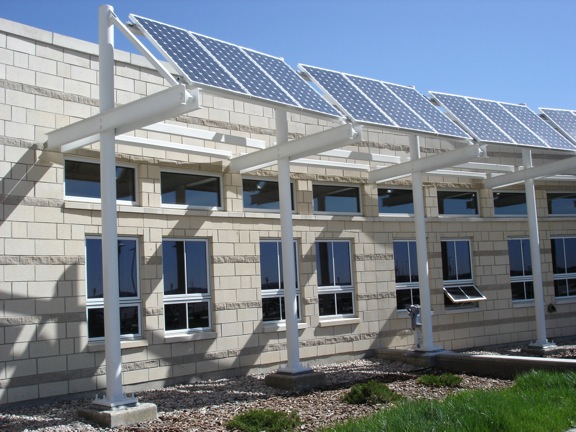 A persistent myth is that PV panels will never produce enough energy in their lifetime to offset the energy used in manufacturing them. This myth has been debunked many times. One recent study, for example, found that PV recoups its manufacturing energy within three years, while the lifespan of PV panels can be 30 or more years.
Renewable energy is perceived as costing too much. Indeed, it is generally far more cost-effective to invest in energy efficiency than to invest in renewable energy generation. However, for many owners, particularly with a long-term view on payback, both investments are worthwhile.
Consider these questions when approaching this credit
- Does the building have a corporate owner that purchases RECs and carbon offsets at the corporate level, that can be applied to the project building? If so, the credit will be particularly easy to meet.
- What opportunities exist for adding onsite renewables to the project building? What are the costs and benefits? What incentives are available?