
Fluorescent lamps are one of the most affordable, efficient, and common lighting technologies. Along with metal halide and other gas-discharge lamps, however, they contain mercury, a toxic element that contributes to water pollution and poses significant human health risks. Use of low-mercury fluorescent lamps, or other mercury-free lighting technologies, reduce the risk of mercury exposure in buildings from broken lamps, and reduces overall mercury consumption. (Don’t let the reduced mercury lull you into complacency about safety in use and disposal, however.)
Implement lamp purchasing guidelines
The credit encourages project teams to develop and implement guidelines for lamp purchases, ultimately reducing the amount of mercury used for lighting below certain limits. When building management controls all lamp purchases, the credit is readily achievable, while multi-tenant buildings with decentralized purchasing may find it more challenging. The level of effort required may also vary depending on the type of lamps and fixtures currently installed in the building.
Start with an inventory
Begin by inventorying all interior and exterior lamps to document the manufacturer, model, and technical specifications, including mercury content. Once this inventory is completed, the project team can use the LEED Online credit form to determine the performance level of the current lamps and fixtures and the level of modifications required meet the credit target. You may need to simply substitute current lamps with lower-mercury alternatives, or you may need to replace fixtures and ballasts that can accommodate low-mercury, high-efficiency lamps. Mercury-free lamps, such as light-emitting diode (LED) lamps, which are particularly suitable for certain specialty applications such as exit signs, exterior architectural lighting, and display case lighting, will count towards reducing the overall average mercury content in your building.
Costs will vary
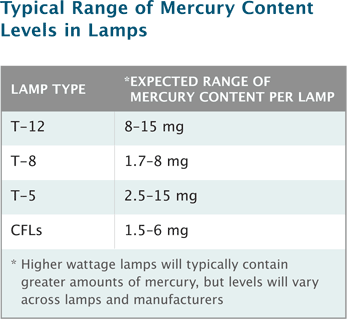
Project costs will vary according to the level of replacement required. In many cases, your lighting vendor can help by identifying low-mercury lamp options that fit the existing fixtures and ballasts; once this plan is in place, you’ll need to commit to purchasing these replacements as existing lamps reach the end of their useful life. There are numerous low-mercury lamp options available for typical lamp types; to help narrow down your options, refer to the table showing the range of mercury content you can expect to see.
Start with these questions
- Does the project building have an accurate inventory of all lamps installed on-site? What is the effort level required to generate such an inventory?
- In multi-tenant facilities, does the project team control lamp purchasing throughout the building? If not, does the project building house any tenants who might be unwilling or unable to share lamp data?
- Are lamp vendors or manufacturer representatives available to support development of a low-mercury lamp purchasing plan?
- Who is responsible for placing purchase orders for lamps? Can they be responsible for tracking lamp purchases over the performance period?
Complete submittals properly
Project teams often confuse the two required data tables on the LEED Online credit form. Both of the following tables are required for earning this credit.
- Table 1.1 represents the Lamp Purchasing Plan, which identifies a list of low-mercury, high-efficiency lamps approved by the project team to use as replacements as existing lamps burn out over time.
- Table 1.2 is a record of all lamp purchases made during the performance period. Table 1.2 serves to confirm that, during the performance period, project teams purchased the proper lamps according to the Lamp Purchasing Plan, and that the average weighted mercury content of the purchased lamps met the mercury target specified in the plan.
CFLs may be excluded
Screw-based compact fluorescent lamps (CFLs) that meet voluntary NEMA guidelines for maximum mercury content may be excluded from both the purchasing plan and the performance calculation. This exclusion option makes credit compliance easier, because CFLs may contain a relatively high amount of mercury compared to a common linear fluorescent lamp. However, CFLs that meet NEMA guidelines are still far more energy-efficient than an equivalent incandescent bulb, so the credit encourages project teams to continue using CFLs to retain the energy benefits without being penalized for the contribution to the overall building mercury levels.